**This is an old revision of the document!**
PlayGround
Test stuff here.
report:intro,report:soa,report:prm,report:mkt,report:sus,report:eth,report:dvp,report:conc
report:intro,report:soa,report:prm,report:mkt,report:sus,report:eth,report:dvp,report:conc
Introduction
This project was developed as part of the European Project Semester (EPS) at ISEP. The EPS programme gives engineering students from different countries and academic fields the opportunity to collaborate on a multidisciplinary project during one semester. Working in an international team allows students to share their knowledge, approach problems from different perspectives, and develop practical solutions to real engineering challenges.
Throughout the semester, the team worked under academic supervision while managing the project and its development. The outcome presented in this report was produced by the group of students listed in Table 1.
Presentation
An overview of the team members and their backgrounds is presented below in Table 1.
| Group member | Background | Origin |
|---|---|---|
| Carlota Isabel Alcaraz Miralles | Mechanical Engineering & Industrial Design | ES |
| Amalie Hjorth Wyke | Health Technology | DK |
| Jordan Kai-ko Jeroen Dorigoni | Architecture & Town Planning | NL |
| Lena Schilling | Information Technology | PL |
| Timon Niedergriese | Data Science | DE |
| Mohammad Yousef Ghaleb Jaber | Computer Engineering | JO |
Motivation
During one of the first sessions, several possible project themes were presented to all of the groups. Each team selected three topics that seemed the most interesting. Our main preferences were Smartification of Buildings, Smart Health & Wellbeing, and Smartification of Everyday Objects. Before making the final decision, the team briefly discussed possible problems and potential solutions within these areas in order to better evaluate which direction could be the most suitable. After the preferences were collected, the topic assigned to our team was Smartification of Buildings. However, the specific problem we eventually decided to address within this theme turned out to be different from the idea we had originally considered during the first brainstorming discussions.
Individual Motivation
- Carlota: I chose the EPS program because, after finishing my individual final degree project, I really wanted a new experience that focused more on teamwork. I was looking for the chance to see how a real project comes to life while working together with people from different backgrounds.
- Amalie: I chose EPS to have the opportunity to work on a project with group members from diverse educational and cultural backgrounds. This collaborative environment creates a dynamic workspace that includes a wide range of perspectives and skills.
- Kai-Ko: I chose the EPS project to have the experience of studying abroad with people from different cultures and education backgrounds. I want to get in touch with the Portugese culture and developing me personally by living abroad and meeting new people.
- Lena: I chose the EPS program to get some hands-on experience and move away from just doing exams. As an IT student, I usually work on digital things, so helping build something tangible while collaborating with people from different countries sounded like a great challenge.
- Timon: I chose the EPS because it offers the opportunity to work on a practical project instead of focusing solely on exams. In addition, I was interested in meeting people from different backgrounds and see it as a great way to develop personally.
- Mohammad: I chose the EPS program because I believe it is the perfect way to spend an Erasmus semester, gaining practical experience without focusing all my energy on regular exams. I also like the idea of being part of a group throughout the semester to spend time together.
Problem
Mental health conditions such as anxiety, depression and chronic stress are the biggest concerns in modern society and workplaces. According to the World Health Organization (WHO) about 1 out of 8 people experience a mental health disorder once in their life [1]. This can occur from high workloads, lack of control or poor support. These mental health issues are not only a personal problem, they also have a high impact on the economy and productivity of companies. WHO estimates that only from depression and anxiety there is a loss of 12 billion working days annually, which is equal to about 1 trillion $ each year due to loss of productivity [2]. In addition poor mental health results in increased absenteeism, difficulties with decision‑making and higher turnover rates.
Research shows that even very short breaks during the workday can have a meaningful impact on employees’ well-being and energy levels. These so-called microbreaks are brief, voluntary pauses from work activities. A study by Kim, Cho, and Park (2022) found that employees who took short breaks throughout the day were better able to manage their energy and stay engaged with their work, particularly on days when they already felt tired [3].
Objectives
With Bloem the objective is to design a small, enclosed space where people are able to take a short break from their stressful daily environments. Often it's difficult to find a relaxing spot in the office. The idea behind Bloem is to create a capsule that reduces the outside noises as well keeping sound in the capsule, so users have a safe space where they feel undisturbed and without affecting others. This shall be achieved with different layers of various materials.
The space should be used for short sessions up to 15 minutes. During that time the user should be engaged to do simple activities like meditation, breathing exercise, stretching or just relax to nature sounds. Soft lighting and calm interior is supposed to back up the whole experience. At the same time the design should be practical and fit into existing spaces.
Overall, Bloem aims to offer a simple way to create moments of calm in otherwise busy environments.
Requirements
The requirements were defined from the user & buyer perspective (not the same), focusing on creating a space that allows short moments of relaxation and mental recovery in busy environments. As a user, I want:
- a quiet and enclosed space where I am not disturbed by outside noise
- a place where I can relax without feeling observed or interrupted
- a noticeable reduction of sound from both inside and outside the capsule
- a comfortable interior where I can sit, lean, or just relax for a few minutes
- a calming atmosphere that helps me relax quickly
- soft, adjustable lighting that is not too bright or distracting
- a space that is easy to enter and use without instructions
- a short-use experience (around 5–15 minutes) that fits into my daily routine
- enough room to feel comfortable, but still compact
- natural or sustainable materials that feel pleasant and not artificial
- a design that feels safe, clean, and inviting
- a space that can be placed in offices or shared environments without taking up too much space
Tests
Functional Tests
Acoustics:
- F1: External speech should be noticeably reduced inside the capsule
- F2: Sound from inside should not be clearly understandable outside
Lighting Environment:
- F3: LED must respond to app control
- F4: Response time should be within 1–2 seconds
- F5: No visible flickering during operation
- F6: Light should feel comfortable for users
Ventilation:
- F7: Sufficient air circulation
- F8: Users feel comfortable while using the space
Technical Tests
Door Functionality:
- T1: Door opens and closes smoothly without excessive force
- T2: Door provides noticeable sound insulation when closed
Stability & Material Performance:
- T3: Capsule structure remains stable under normal use
- T4: Materials withstand repeated use and materials are easy to clean
Usability Tests
User-Friendliness:
- U1: The app should be intuitive to use without instructions
- U2: Main app functions (color selection and music) should be intuitive to use
User Experience:
- U3: Lighting changes should feel smooth and responsive during use
- U4: Users should experience the capsule environment as comfortable and relaxing
Report Structure
| Chapter | Description |
|---|---|
| 1. Introduction | Overview of the project, team, and objectives. |
| 2. Background and Related Work | Key research and existing solutions. |
| 3. Project Management | Team organization and workflow. |
| 4. Marketing Plan | Target audience and promotion strategy. |
| 5. Eco-efficiency Measures for Sustainability | Environmental and social considerations. |
| 6. Ethical and Deontological Concerns | Moral and ethical implications. |
| 7. Project Development | Steps and iterations from concept to solution. |
| 8. Conclusions | Summary of results and lessons learned. |
Background and Related Work
Introduction
To develop the best possible product for the market, it is essential to investigate existing solutions. Therefore, this section presents a state-of-the-art review, including an analysis of five products that either offer similar functionality or provide user experience comparable to what we aim to achieve with our product. Finally, these products are compared to identify their strengths and weaknesses in relation to our solution in a comparative analysis.
Concepts
Bloem is designed as a private space that supports brief mental breaks during the day. A dedicated environment for restoration rather than productivity. Unlike conventional office settings, it prioritizes mental recovery, giving users a moment to step away from constant demands. In today’s fast-paced, efficiency-driven routines, even short pauses can make a real difference, reducing stress and mental fatigue.
Research shows that short, structured breaks during work help relieve cognitive load and restore mental energy. A recent meta-analysis found that regular micro-breaks significantly lower fatigue and boost energy, even in high-pressure, productivity-focused workdays [4].
Key aspects include:
- The user experience
- Privacy and personal space
- Sensory stimulation
By combining light, sound, airflow and an enhanced sense of personal privacy, the dome creates an immersive micro-environment that supports short-term restoration and enhances well-being in busy, demanding settings.
Products
In this section, we describe products that are comparable to our solution but are already available on the market.
Figure 1 shows the Framery Pod, a workspace and meeting pod designed for office buildings and universities. Instead of traditional meeting rooms, some workplaces use smaller, sound-insulated pods for focused group work. The Framery Pod includes features as sound insulation (up to 30 dB), adjustable lighting, ventilation, and USB/power outlets. Framery provides a flexible space where group work can be optimized in a controlled, sound-insulated environment, offering separation from the surrounding office area [5].

Figure 2 shows the Breehealth pod. It is a high-tech relaxation capsule designed for rest and mental recovery. The design is large and visually dominant, making it a clear focal point in the space. The user sits in a zero-gravity massage chair inside the capsule, creating a supported resting position. Unlike more open designs, the pod is non-transparent, ensuring a high level of privacy as users are fully enclosed and shielded from their surroundings. This enhances the sense of separation from the external environment. The pod includes features such as guided meditation programs, an integrated audio system, light therapy, and sound reduction, all supporting both physical relaxation and mental well-being [7].

Figure 3 shows a Relax-Space-Wellness-Pod. It is a chair designed for mental wellness breaks, offering a semi-private experience that allows users to step away from a busy workday. The pod includes features such as guided breathing exercises and heated seating, which help users relax and feel refreshed [9]. However, in our opinion, the design may appear somewhat out of character in a typical office environment. Therefore, careful consideration should be given to its placement within the building to ensure it integrates well with the surrounding space. It is also important to note that the pod is not fully private, which should also be taken into consideration when choosing its location.

Figure 4 shows the Inhere meditation pod. Here, we see an example of a more private space that users can enter. Overall, it is very simple, with no integrated technology, featuring a clean and minimalist architectural design [11]. However, since there is no solid material between the wooden panels, the space is not truly private or soundproof. The capsule feels aesthetically integrated into the room and may create a “room within a room” effect, but it does not provide a complete sense of isolation or the full experience of being alone and able to recharge during the workday.

Figure 5 shows the Iris Pod. This is the closest example to the product we aim to create. It is a private space where the user is alone inside an enclosed capsule. The pod includes technology such as dimmed lighting, guided meditation, and ventilation [13]. The capsule is not fully soundproof and instead provides noise isolation through headphones. This is an area where we aim to differentiate ourselves from the existing product.

To compare the existing products on the market, we have listed them in table 3 below. It is a combined comparison of the products in terms of price, use cases, acoustics, and technological features. This provides a good overview of the products that are already available on the market.
| Product | Cost (€) | Purpose | Acoustic Performance | Smartness |
|---|---|---|---|---|
| Framery Four | 19 900 | Supports focused work and small-group collaboration | Approx. 30 dB sound reduction | Lighting control, ventilation, and power outlets |
| BreeHealth | 20 000-25 000 | Workplace relaxation and well-being | Not specified | Zero-gravity massage chair, guided meditation, audio system, light therapy, and sound reduction |
| RelaxSpace | 29 000 | Mindfulness, meditation, and recovery | Not specified | Personalized sessions with visuals, guided breathing, scents, and heated seating |
| Inhere | 8 900 | Well-being space | Minimal sound reduction (~0 dB) | No integrated technology |
| Iris | 19 800 | Meditation-focused pod | Noise-isolating headphones | Calming light, meditation, airflow, and tablet interface |
All products are positioned within the higher price range. However, when considering their respective use cases, purposes, and levels of sound insulation, they are designed to address different needs. Therefore, it is essential to carefully evaluate which features and characteristics are most relevant for Bloem.
Projects
Unfortunately, there are no direct research projects examining how a relaxation pod might affect people’s mental health, as it is a rather unique product and such solutions have not been on the market for very long. Furthermore, these products aim to incorporate existing stress reduction techniques. However, there are studies that examine how soundproof or acoustic pods, meditation and short breaks promote mental health. Some of these studies are mentioned below, and their findings are briefly explained. Taken together, they paint a picture of how a relaxation pod can be beneficial in work environments.
The available studies provide consistent evidence that both the physical design of work environments and targeted recovery have a significant impact on employees’ well-being and performance. Acoustic interventions, in particular, appear to play a central role in this regard. For example, the study by Radun, Jokinen, and Kärki (2025) shows that the introduction of soundproofed retreat areas in a real-world office environment with 58 employees led to a significant increase in satisfaction with the acoustic environment as well as the general work atmosphere [15]. The high acceptance of these so-called soundproof pods underlies their practical relevance for modern office concepts, particularly in open-plan work environments where noise pollution is often perceived as disruptive. In addition, a parametric study on semi-enclosed meeting pods provides nuanced insights into the underlying acoustic mechanisms. The results show that, in particular, the combination of sound-absorbing materials and strategically placed reflective surfaces improves speech intelligibility within the pods while simultaneously reducing sound transmission to the outside [16]. These findings illustrate that it is not only the presence of such retreat spaces that is crucial, but also their specific material and design specifications. Furthermore to optimize the physical work environment, behavioral interventions also demonstrate positive effects. A comprehensive meta-analysis by Goyal et al. (2014) demonstrates that meditation programs including mindfulness based approaches lead to significant reductions in stress and anxiety, as well as improvements in general well-being, both in the short and long term [17]. These findings suggest that even short, structured relaxation breaks during the workday can serve as a relevant complement to spatial interventions. Findings on the effects of micro-breaks during work also point in a similar direction. Cho (2022) shows that short, self initiated interruptions such as stretching exercises, small snacks, or social interactions help maintain energy levels and boost work performance [18]. These breaks are particularly effective when they are chosen situationally and independently by employees, which highlights the importance of autonomy in the work context. In summary, it can be stated that both acoustically optimized quiet spaces and short regenerative interventions represent complementary strategies for improving the quality of the work environment. While structural measures such as soundproof pods primarily help reduce external stressors, practices like meditation and micro-breaks primarily address individual stress management. The combination of both approaches therefore appears particularly promising for designing health-promoting workplaces.
Comparative Analysis
Based on the products above, it is evident that existing workspace solutions such as meeting pods primarily focus on improving productivity, communication, and overall office efficiency. While these products often provide strong acoustic performance and functional design, they are generally not intended to support mental recovery or offer meaningful breaks from daily work activities.
Relaxation-oriented solutions such as BreeHealth and RelaxSpace provide opportunities to withdraw from the work environment. However, these concepts are highly stationary. Users remain seated in a position, with limited opportunity for physical movement or bodily awareness. Although both solutions represent strong approaches to workplace well-being, they lack, in our view, a balance between movement, privacy, and acoustic isolation.
The Inhere pod introduces a more minimal experience, aligning with some of the qualities we aim to achieve. The Iris pod is the solution most closely aligned with our intended direction, as it combines relaxation features with a more enclosed experience. We aim to extend this concept further by integrating acoustic isolation.
Energy pods generally provide opportunities for rest, but our research has revealed a lack of sufficient acoustic separation and privacy. This highlights a gap between productivity-oriented spaces and relaxation-focused solutions. Existing products tend to support either work efficiency or short-term recovery, but rarely combine acoustic isolation, visual privacy, and true disconnection from the work environment.
Summary
Based on these findings above, the proposed design adopts a closed, non-transparent capsule architecture combined with acoustic insulation materials and a comfort-oriented interior. This approach ensures a high level of sound reduction, visual isolation, and psychological detachment from the surrounding environment. In addition, the integration of controlled lighting, calming audio, and guided meditation supports mental recovery and pause during the workday.
This design direction prioritizes user well-being, mental recovery, and sensory reduction over productivity and collaboration.
In the following chapters, the proposed solution will be presented in detail. The next section will focus on project management and how the development process is planned and executed.
Project Management
Provide here an overview of the contents (structure) of this chapter. Explain the project management approach your group followed and justify why you think it is a good approach.
Scope
Defining the scope of Bloem is essential for keeping our efforts focused on the project's core objectives. By mapping out exactly what is included in the project, we can prevent scope creep and make sure every team member understands the roadmap. The Work Breakdown Structure (WBS) in Figure 6 below illustrates how we have divided the project into manageable phases to ensure we reach a successful final prototype.

Time
3.2 Time
In this section, we lay out the schedule and all the major deadlines we have to hit throughout the semester. This is shown in Table 4. Tracking these milestones is really important because it keeps the whole team accountable and makes sure we're actually making steady progress on Bloem. It also helps us see if we're falling behind early on, so we can fix things before they become a real problem.
| Task | Proposed date |
|---|---|
| Choose the project proposal | 2026-02-28 |
| System Diagrams & Structural Drafts | 2026-03-11 |
| List of Components and Materials | 2026-03-18 |
| Project Backlog, Global Sprint Plan, Initial Sprint Plan and Release Gantt Chart | 2026-03-21 |
| System Schematics, Structural Drawings and cardboard scale model | 2026-03-25 |
| Interim Report and Presentation | 2026-04-12 |
| Interim Presentation | 2026-04-16 |
| 3D model video | 2026-04-22 |
| Final List of Materials | 2026-04-29 |
| Refined Interim Report | 2026-05-02 |
| Packaging Solution | 2026-05-13 |
| Functional Tests | 2026-05-27 |
| Final Report, Presentation, Video, Paper, Poster and Manual | 2026-06-13 |
| Final Presentation | 2026-06-18 |
| Demonstration of the operation of the prototype | 2026-06-25 |
Cost
The cost analysis for this project considers both the physical components required to build the Bloem prototype and the estimated personnel effort needed to design, develop, and integrate the final solution. Based on the current Bill of Materials, the project cost is mainly driven by the structural elements of the capsule, while the electronic system represents a smaller but essential part of the total investment.
3.3.1 Material Cost
The list of materials below summarizes the components required for the construction of the Bloem capsule, including structural materials, interior elements, control hardware and electronic components.
| Category | Component | Quantity | Unit Price | Total Price | Link |
|---|---|---|---|---|---|
| Materials | Cork insulation GO4CORK | 11 | 28.89 € | 317.79 € | Link |
| Materials | Planed wooden slat WHITE CASQUINHA | 16 | 4.09 € | 65.44 € | Link |
| Materials | SPAX Screws | 1 | 5.69 € | 5.69 € | Link |
| Materials | Hemp Granules 15 | 9 | 28.41 € | 255.69 € | Link |
| Materials | Plywood Interior Poplar B/BB (Wooden Shell) | 6 | 48.55 € | 291.30 € | Link |
| Materials | Wide Square k2 L-brackets | 2 | 1.29 € | 2.58 € | Link |
| Materials | Pattex Wood Glue | 1 | 6.96 € | 6.96 € | Link |
| Materials | Birch plywood board (wooden floor) | 2 | 58.81 € | 117.62 € | Link |
| Materials | Plywood Interior Poplar B/BB (Door) | 2 | 45.00 € | 90.00 € | Link |
| Materials | Door Hinges 100 | 6 | 10.99 € | 65.94 € | Link |
| Materials | Soft seating fabric | 6 | 13.36 € | 80.16 € | Link |
| Materials | Foam flakes filling | 24 | 4.84 € | 116.16 € | Link |
| Materials | Birch plywood board (seat frame) | 2 | 58.81 € | 117.62 € | Link |
| Materials | Galaxy Tab A9 | 1 | 159.00 € | 159.00 € | Link |
| Materials | Tablet holder DURABLE 893323 | 1 | 88.71 € | 88.71 € | Link |
| Materials | PLA GO&PRINT White | 15 | 13.97 € | 209.55 € | Link |
| Electrical | ESP32-S3 Development Board | 1 | 13.90 € | 13.90 € | Link |
| Electrical | RGB LED Strip | 1 | 16.00 € | 16.00 € | Link |
| Electrical | Speaker GAT-801 | 1 | 28.91 € | 28.91 € | Link |
| Electrical | N-channel MOSFET | 1 | 17.90 € | 17.90 € | Link |
| Electrical | Resistor set | 1 | 11.85 € | 11.85 € | Link |
| Electrical | BH1750 Light sensor | 1 | 4.00 € | 4.00 € | Link |
| Electrical | LM2596 Buck Converter | 1 | 5.72 € | 5.72 € | Link |
| Electrical | Red/Black Wire | 1 | 3.51 € | 3.51 € | Link |
| Electrical | 12 V Power Supply | 1 | 10.50 € | 10.50 € | Link |
| Shipping | All suppliers combined | 1 | 437.49 € | 437.49 € | - |
| Total Material Cost | 2539.99 € |
The total material cost of the Bloem prototype is therefore 2539.99 €. Most of this value comes from the structural and interior construction materials, especially the cork insulation, plywood panels, flooring, and seating structure. The electronic system has a comparatively lower cost, with a total of 133.78 €, while still enabling the interactive lighting and sound features required by the concept.
3.3.2 Personnel Cost
In addition to the material cost, the development of Bloem also involves a significant personnel investment. This includes the time dedicated to concept development, structural design, 3D modelling, UI design, electronics integration, sourcing, testing, and documentation. Considering a multidisciplinary student team working on the project over a full semester, the personnel effort represents a much higher value than the prototype materials alone.
Assuming a team of six members, each contributing an average of 6 hours per day over a four-month period, excluding weekends, the total effort corresponds to approximately 3168 working hours. Using a reference rate of 14.00 €/h, the estimated personnel cost is 44 352.00 €.
When combining the physical materials with the estimated labor effort, the total project value of Bloem is 46 891.99 €.
Quality
For the Bloem project, quality management ensures that both the final deliverable meets high engineering standards and the development process itself is efficient and reliable. Therefore, we define and monitor quality across two primary domains: the physical product and the project execution.
Product Quality (Physical Performance & Specifications)
The physical prototype of the Bloem capsule must adhere to strict technical and structural specifications to ensure a safe and relaxing user experience. Quality in this domain is evaluated based on the following explicit material and functional requirements:
- Resilience and Durability: The structure must withstand daily entry, exit, and usage. The sustainable materials selected (cork and hemp insulation) must not easily degrade, warp, or tear under normal indoor environmental conditions.
- Weight Load Capacity: The structural frame and base must safely hold specified weight loads. The seating area is designed to support a user weighing up to 150 kg without any structural deformation or stress fractures.
- Dimensional Tolerance: Precision in assembly is critical to maintaining the egg-shaped geometry. The overall structural dimensions have an acceptable tolerance of ±2.0 cm. For connecting joints and the sliding door track, the tolerance is restricted to ±0.5 cm to ensure smooth, friction-less operation.
- System Functionality: Every smart feature—including the ESP32 sensor integration, lighting, and tablet interface—must operate seamlessly. The user must experience low-latency responses when controlling the internal environment.
- Environmental Impact: The product must utilize locally sourced, bio-based materials to maintain a low carbon footprint and adhere to a circular design philosophy.
Project Quality (Process Quality & Delivery Reliability)
To guarantee a successful and professional outcome, we apply strict quality standards to our teamwork, workflow, and documentation.
- Process Quality: High process quality means accurately estimating our effort breakdowns, completing planned sprint tasks with carrying them over only rarely and ensuring clear communication across our team.
- Delivery Reliability: All project milestones—such as the Interim Report, Final Presentation, and Prototype Assembly—must be delivered fully complete and strictly on time.
- Documentation Standards: All reports and wiki pages must maintain consistent formatting. Explanations must be direct and easy to read and all documents must feature the ISEP and Bloem brand logos using the established color palette.
Quality Control Table
To systematically verify these requirements during the assembly and testing phases, we use the following quality control matrix.
| What is observed/checked | Acceptance Criterion | Allowed Deviation Range |
|---|---|---|
| Overall Structure Dimensions | Matches the 3D CAD model specifications | ± 2.0 cm |
| Joint / Door Alignment | Sliding door opens and closes smoothly | ± 0.5 cm |
| Structural Load / Weight | Base and seating safely support a user | Max 150 kg (No lower deviation allowed for safety) |
| Material Finish | Cork and hemp panels are securely glued; no peeling | ± 2.0 mm gap tolerance |
| App-to-Hardware Latency | LEDs and music change state upon app input | < 100 ms |
3.5 People and Stakeholder Management
At the beginning of the project the team assessed its academic backgrounds to establish initial leads for technical and structural domains. However, recognizing the highly integrated nature of the Bloem capsule, the team adopted a flexible operational model. Resource allocation is adjusted during weekly sprint planning and meetings to ensure a balanced workload.
Beyond the internal team, external stakeholders play a crucial role in the project's viability. To manage these relationships effectively, a structured stakeholder classification model is used, analyzing the following dimensions:
- Power vs. Influence: It is vital to distinguish between decision authority and the ability to affect outcomes. Power refers to formal authority (e.g., grading, funding approval, administrative sign-off), whereas Influence dictates how much a stakeholder can steer the project's success through technical advice, resources, or feedback.
- Type of Influence and Impact: Each stakeholder is evaluated on their level of influence (Low, Medium, or High) and their impact—meaning how strongly they are personally or professionally affected by the project's outcome.
- Level of Support: Stakeholders are categorized by their stance: Supporter (actively aids the project), Neutral (neither helps nor hinders), Blocker (potential source of delay, such as supply chain bottlenecks), or Decision-Maker (holds the ultimate authority on project progression).
Table 7 outlines this classification for the Bloem project.
| Stakeholder | Description | Power | Influence | Impact | Level of Support |
|---|---|---|---|---|---|
| Team Bloem | Core group responsible for the design and build. | Medium | High | High | Supporter |
| Project Supervisors | Advisors providing technical and academic guidance. | High | High | Medium | Decision-Maker / Supporter |
| Benedita Malheiro | EPS Coordinator managing the program structure. | High | Medium | Low | Decision-Maker |
| ISEP | Main sponsor providing workspace and funding. | High | High | Low | Supporter |
| Office Workers | End-users providing needs and UX feedback. | Low | Medium | High | Neutral / Supporter |
| Suppliers | External providers for cork, hemp, and electronics. | Low | Medium | Low | Neutral / Blocker (if delayed) |
Stakeholder Communication Strategy
To ensure each stakeholder receives the appropriate information without being overwhelmed, communication is tailored based on their classification:
- Internal Team (Team Bloem):
- How: WhatsApp for rapid alignment, MS Teams for documentation.
- Frequency: Daily.
- Detail Level: Extremely detailed and highly technical.
- Project Supervisors & EPS Coordinator:
- How: In-person meetings, MS Teams and email.
- Frequency: Weekly.
- Detail Level: Medium to high. Focuses on progress overviews, milestone achievements, and specific technical or ethical obstacles.
- Target Group (Office Workers):
- How: Surveys, interviews, and prototype testing sessions.
- Frequency: Phase-based (Research and Testing phases).
- Detail Level: High-level, focusing entirely on user experience, ergonomics, and functional feedback rather than technical mechanics.
- Suppliers:
- How: Email and direct phone calls.
- Frequency: As needed during the procurement phase.
- Detail Level: Highly specific regarding material specifications, dimensional tolerances, quantities, and delivery timelines.
3.6 Communications
Effective synchronization is essential to manage all components of the Bloem project. To maintain progress, the team utilizes specific tools to stay connected. Daily communication occurs via WhatsApp, facilitating quick coordination and immediate problem-solving when issues arise. For formal documentation, Microsoft Teams serves as the central repository for report drafts and all project files. Additionally, the team relies on Jira to manage weekly sprints, providing clear visibility into task assignments and current project status.
Information Flow To ensure organized and professional communication, project information is distributed strictly according to stakeholder relevance:
- Internal Team: Receives raw data, design drafts, daily task updates, and internal meeting minutes.
- Project Supervisors & EPS coordinator Receive weekly progress summaries, milestone deliverables and formal technical/academic questions.
Table 8 shows the general communication channels established for interactions with these stakeholders.
| Stakeholder | Channel | Frequency | Purpose |
|---|---|---|---|
| Team Bloem | WhatsApp, Teams & In-person | Daily / As needed | Quick updates, file sharing, and internal coordination. |
| Project Supervisors | MS Teams & In-person | Weekly | Presenting progress and receiving feedback on the work. |
To structure the workflow, specific recurring meetings have been established. Table 9 outlines the formal meeting schedule.
| Type of Meeting | Who (Participants) | What (Purpose) | When / Frequency | Communication Channel |
|---|---|---|---|---|
| Daily Sync | Team Bloem | Quick status updates, identifying immediate blockers. | Daily | |
| Sprint Planning | Team Bloem | Reviewing completed work and assigning Jira tasks. | Weekly | In-person |
| Supervisor Meeting | Team Bloem & Supervisor Panel | Presenting weekly progress, discussing milestones, and addressing specific technical or ethical domain questions. | Weekly | In-person / MS Teams |
| Working Sessions | Team Bloem | Active physical prototype development and software integration. | Multiple times a week | In-person |
Issue Escalation Protocol When challenges or technical blockers arise, the team follows a defined escalation path to resolve issues efficiently and prevent project delays:
- Level 1 (Internal Resolution): The issue is first raised via WhatsApp or during a daily working session. The multidisciplinary team attempts to troubleshoot and resolve it internally within 24 to 48 hours.
- Level 2 (Supervisor Escalation): If the issue persists, requires specific academic guidance, or impacts the budget, it is documented and formally brought to the relevant Project Supervisor (e.g., addressing structural questions to the mechanics supervisor or UI questions to the IT supervisor) during the weekly meeting.
Risk
3.7 Risk Management
Risk management is essential to identify, evaluate, and mitigate potential issues that may arise during the development and implementation of the Bloem capsule. Each identified risk is assessed based on its probability of occurrence and its potential impact on the project. A 5×5 risk matrix is used to classify risks and support decision-making regarding mitigation strategies. This matrix is shown in Figure 7.

Table 10 shows a risk assessment of the system. Here is a definition of the probability and impact levels.
The probability levels are defined as:
- 5: Almost certain
* 4: Likely
* 3: Moderate
* 2: Unlikely
* 1: Rare
The impact levels are defined as:
- 5: Severe
* 4: Major
* 3: Significant
* 2: Minor
* 1: Insignificant
Risk levels are calculated by multiplying probability by impact and are interpreted as:
- 1–4: Acceptable
* 5–9: Adequate
* 10–16: Tolerable
* 17–25: Unacceptable
| Risk | Probability | Impact | Risk level | Response | Risk handling |
|---|---|---|---|---|---|
| Hardware integration issues (LEDs, sensors, ESP32 not working together) | 3 | 4 | 12 - Tolerable | Mitigate | Perform early prototyping and incremental testing of all electronic components |
| Tablet/app connectivity problems (communication between tablet and system fails) | 3 | 4 | 12 - Tolerable | Mitigate | Use reliable communication protocols and test integration regularly |
| User interface usability issues (confusing booking or controls) | 3 | 3 | 9 - Adequate | Mitigate | Conduct user testing and iterate UI design based on feedback |
| Structural instability of the capsule (design or assembly weaknesses) | 2 | 5 | 10 - Tolerable | Mitigate | Validate structure through simulations and reinforce critical joints |
| Delays in material delivery or unavailable components | 2 | 3 | 6 - Adequate | Transfer | Identify alternative suppliers and order materials early |
| Time management issues within the team | 3 | 3 | 9 - Adequate | Mitigate | Establish clear deadlines and monitor progress regularly |
| System does not provide expected relaxation experience | 2 | 4 | 8 - Adequate | Mitigate | Test lighting and sound scenarios and adjust based on user feedback |
| Power supply or electrical failure inside the capsule | 2 | 5 | 10 - Tolerable | Mitigate | Ensure proper circuit design and include safety measures (fuses, regulators) |
| Overcomplication of features leading to unfinished implementation | 3 | 4 | 12 - Tolerable | Avoid | Prioritize core functionalities and reduce scope if necessary |
| Legal or safety compliance issues (indoor installation, user safety) | 2 | 4 | 8 - Adequate | Mitigate | Follow safety guidelines and ensure materials and electronics meet standards |
The risk analysis shows that most identified risks fall within the adequate and tolerable categories. These risks can be managed through proper planning, iterative testing, and continuous monitoring throughout the project lifecycle. No risks were classified as unacceptable, meaning the project is considered feasible within the defined scope, provided that mitigation strategies are effectively implemented.
Procurement
3.8 Procurement
Procurement is an important part of the Bloem project because the solution combines architectural materials, furniture elements, and electronic components that must be acquired from different types of suppliers. For this reason, the purchasing strategy was defined to balance cost, availability, delivery time, and reliability, while also keeping the overall concept feasible from a construction point of view. Our procurement plan is shown in Table 11.
The structural and interior elements of the capsule are mainly sourced from building-material suppliers and wood specialists. Components such as cork insulation, wooden slats, plywood boards, brackets, and adhesives are purchased from suppliers that can provide materials in the required dimensions and in relatively short lead times. Whenever possible, local or regional suppliers are preferred, since this reduces transportation effort and simplifies replacement in case of damaged or unavailable items.
The electronic subsystem follows a different procurement approach. Microcontrollers, sensors, converters, and low-cost supporting modules are acquired from specialized online suppliers, since these components are generally more affordable and easier to find through international platforms. At the same time, items such as the speaker and LED strip are sourced from retailers with faster shipping and easier purchasing conditions. Backup suppliers are also identified for the most relevant electronic elements in order to reduce the risk of delays during assembly and testing.
For the user interface, the team selected a commercial tablet that offers sufficient performance for session booking and environmental control without requiring advanced specifications. This avoids overspending on hardware while still ensuring that the interface can be demonstrated under realistic conditions.
Overall, the procurement strategy for Bloem is based on using reliable suppliers for large structural materials, specialized vendors for electronics and alternative sources whenever delivery or stock issues may arise. This mixed approach provides flexibility during implementation and supports both the physical construction of the capsule and the integration of its interactive features.
| Item | Primary Supplier | Primary Price | Primary Shipping (Days) | Backup Supplier | Backup Price | Shipping Time (Days) | Notes |
|---|---|---|---|---|---|---|---|
| Cork insulation GO4CORK | Leroy Merlin | 317.79 € | 1–3 | Casa Peixoto | 362.70 € | 1–3 | Main acoustic and thermal insulation material |
| Planed wooden slat WHITE CASQUINHA | Leroy Merlin | 65.44 € | 1–3 | Casa Peixoto | 95.85 € | 0–2 | Used for internal wooden framing |
| SPAX Screws | KuantoKusta | 5.69 € | 1–3 | Leroy Merlin | 18.99 € | 0–2 | Fastening elements |
| Hemp Granules 15 | Datapixel | 255.69 € | 2–5 | Leroy Merlin | 279.72 € | 1–3 | Complementary insulation material |
| Plywood Interior Poplar B/BB | ToSize | 291.30 € | 3–7 | Maderterraneo | 390.00 € | 2–5 | Main shell material |
| Wide Square k2 L-brackets | Leroy Merlin | 2.58 € | 1–3 | Macovex | 6.00 € | 0–2 | Structural reinforcement |
| Pattex Wood Glue | Worten | 6.96 € | 0–2 | Leroy Merlin | 36.85 € | 0–2 | Wood adhesive |
| Birch plywood board (floor) | Madeiras Leiria | 117.62 € | 1–3 | Madeiras Leiria | 235.24 € | 1–3 | Flooring base |
| Plywood Poplar (door) | Maderterraneo | 90.00 € | 2–5 | ToSize | 97.10 € | 2–5 | Sliding door panel |
| Birch plywood board (seat frame) | Madeiras Leiria | 117.62 € | 1–3 | Leroy Merlin | 429.00 € | 1–3 | Seating structure |
| Tablet holder | Worten | 88.71 € | 0–2 | Manutan | 114.08 € | — | Mounting system |
| Soft seating pillowcase | Texland | 80.16 € | 1–3 | Loja Tecidos | 117.00 € | 1–3 | Upholstery fabric |
| Cushion filling material | 100metros | 116.16 € | 1–3 | Feira dos Tecidos | 83.40 € | — | Foam filling |
| Hinges Door | Leroy Merlin | 65.94 € | 1–3 | Fruugo | 179.70 € | 1–3 | Door hinges |
| Outside panels (PLA) | Evolt | 209.55 € | 2–5 | Reprap | 240.00 € | — | Exterior panels |
| Galaxy Tab A9 | Worten | 159.00 € | 0–2 | Staples | 200.00 € | 0–2 | Interface device |
| ESP32-S3 board | Mauser | 13.90 € | 5–10 | Mauser | 10.14 € | 5–10 | Controller |
| RGB LED strip | Worten | 16.00 € | 1–3 | Botnroll | 12.50 € | 1–3 | Lighting |
| MOSFET transistor | Worten | 17.90 € | 1–3 | Mauser | 11.40 € | 1–3 | Switching |
| Resistor set | Worten | 11.85 € | 1–3 | Mauser | 50.00 € | 1–3 | Electrical support |
| Red/Black Column Wire | Mauser | 3.51 € | 2–5 | DigiKey | 3.50 € | 5–10 | Electrical support |
| BH1750 sensor | DigiKey | 4.00 € | 5–10 | Mauser | 5.50 € | 5–10 | Light sensing |
| LM2596 converter | Mauser | 5.72 € | 5–10 | DigiKey | 20.22 € | 5–10 | Power regulation |
| 12V power supply | Mauser | 10.50 € | 5–10 | Thomann | 20.90 € | 5–10 | Power supply |
| Speaker GAT-801 | Mauser | 28.91 € | 2–5 | KuantoKusta | 39.67 € | 1–3 | Audio output |
| Total Estimated Cost | 2539.99 € | 2786.73 € |
Procurement presents significant risks in three areas: price fluctuations, delivery times, and supplier dependencies. There are sometimes substantial price differences between primary and backup suppliers that cannot be explained solely by market variations but are usually attributable to differences in packaging sizes, quality grades, or distribution channels (retail vs. B2B). Particularly notable are wood and fastening materials such as wood glue, hinges, screw sets, and individual wood panels, where prices vary by a factor of approximately 2 to 5 depending on the supplier. This creates a procurement risk, as actual unit costs depend heavily on the chosen supplier and are not consistently comparable across all sources.
In terms of time, the system is clearly segmented: local retailers such as Leroy Merlin or Worten typically deliver within 0–3 days, while specialized dealers for wood or material products tend to require 2–5 days. Electronics components sourced through distributors like Mauser or DigiKey, on the other hand, have the longest shipping times of up to 5–10 days. This creates a critical path in project planning, as microcontrollers, sensors and power components in particular can delay the entire system integration if they are not available on time.
Another risk stems from de facto single-supplier structures. Some components either have identical primary and backup suppliers or have only very limited interchangeable alternatives. This increases dependence on individual distributors and makes the system vulnerable to stockouts or delivery delays, particularly in the electronics sector.
This results in a clear procurement strategy with two modes: Under normal circumstances, the cheapest supplier is selected to minimize total costs. In time-critical phases or when bottlenecks are imminent, however, the system deliberately switches to the fastest available supplier, even if this results in higher costs. This dual strategy strikes a balance between budget efficiency and project security while reducing the risk of delays on the critical path.
Project Plan
The project is organized into one-week sprints to support an iterative and flexible development workflow. The full timeline is presented in Table 12, which serves as a structured reference for monitoring progress and ensuring alignment with the overall project goals.
| Sprint | Start | Finish | Status |
|---|---|---|---|
| 1 | 26/02/2026 | 04/03/2026 | Finished |
| 2 | 05/03/2026 | 11/03/2026 | Finished |
| 3 | 12/03/2026 | 18/03/2026 | Finished |
| 4 | 19/03/2026 | 25/03/2026 | Finished |
| 5 | 26/03/2026 | 01/04/2026 | Finished |
| 6 | 02/04/2026 | 08/04/2026 | Finished |
| 7 | 09/04/2026 | 15/04/2026 | Finished |
| 8 | 16/04/2026 | 22/04/2026 | Finished |
| 9 | 23/04/2026 | 29/04/2026 | Finished |
| 10 | 30/04/2026 | 06/05/2026 | Finished |
| 11 | 07/05/2026 | 13/05/2026 | Finished |
| 12 | 14/05/2026 | 20/05/2026 | Finished |
| 13 | 21/05/2026 | 27/05/2026 | Ongoing |
| 14 | 28/05/2026 | 03/06/2026 | Planned |
Our project backlog works as a roadmap for the team, helping us stay on top of all the EPS milestones. We’ve arranged these tasks to make sure the workflow stays consistent and that we're hitting our deadlines as we build Bloem. The detailed list of these items and their current status is provided in Table 13 below.
| PBI | Title | Status |
|---|---|---|
| A | Define project theme | Done |
| B | Upload “black box” System Diagrams & Structural Drafts | Done |
| C | Upload List of Components and Materials (draft) | Done |
| D | Define Project Backlog, Global Sprint Plan & Initial Sprint Plan | Ongoing |
| E | Release Gantt Chart of the project | Done |
| F | Upload Detailed System Schematics & Structural Drawings | Done |
| G | Cardboard scale model of the structure | Done |
| H | Interim Report and Presentation | Done |
| I | 3D model video | Ongoing |
| J | Final List of Materials | Done |
| K | Refined Interim Report (based on feedback) | Done |
| L | Packaging solution | Done |
| M | Results of the Functional Tests | Ongoing |
| N | Building the prototype | Ongoing |
| O | Final Report, Presentation, Video, Paper, Poster and Manual | Planned |
| P | Final Presentation, Individual Discussion and Assessment | Planned |
| Q | MS Teams folder upload (refined deliverables + code + drawings) | Planned |
To manage our time effectively, we’ve broken the project down into one-week 'sprints.' This allows us to focus on specific tasks each week and ensures that we are making steady progress toward our final goals. Table 14 shows our schedule, including the duration of each task and who is responsible for leading them.
| Sprint | Task | Importance | Responsible | Involved |
|---|---|---|---|---|
| 26/02/2026 - 04/03/2026 | ||||
| 1 | Choose and share top-3 preferred project proposals | 5 | Everyone | Everyone |
| 05/03/2026 - 11/03/2026 | ||||
| 2 | “Black box” System Diagrams | 3 | Everyone | Everyone |
| 2 | Structural Drafts | 4 | Carlota | Everyone |
| 2 | Write Background and Related Work chapters | 3 | Amalie & Timon | Everyone |
| 2 | Brainstorm other ideas inside the Smart Buildings topic | 5 | Everyone | Everyone |
| 12/03/2026 - 18/03/2026 | ||||
| 3 | Research Components and Materials | 3 | Everyone | Everyone |
| 3 | List of Components and Materials (initial upload) | 5 | Amalie & Lena | Everyone |
| 3 | Write Marketing chapters | 2 | Timon | Everyone |
| 3 | Improve BlackBox Diagram | 2 | Lena | Everyone |
| 19/03/2026 - 25/03/2026 | ||||
| 4 | Detailed System Schematics | 5 | Amalie | Everyone |
| 4 | Structural Drawings | 5 | Carlota | Everyone |
| 4 | Cardboard scale model of Bloem | 3 | Kaiko | Everyone |
| 4 | Create a flyer draft | 3 | Kaiko | Everyone |
| 4 | Update Material List | 3 | Mohammed | Everyone |
| 4 | Settle on a name and logo | 4 | Everyone | Everyone |
| 4 | Write Project Plan & Development chapters | 2 | Lena & Carlota | Everyone |
| 26/03/2026 - 01/04/2026 | ||||
| 5 | Reworking Schematic Drawings | 4 | Amalie | Everyone |
| 5 | Creating Case Study Presentation (Ethics) | 3 | Mohammad | Everyone |
| 5 | Creating the brand identity | 4 | Carlota | Everyone |
| 5 | Updating marketing brand | 3 | Timon | Everyone |
| 5 | Smart System HW | 5 | Amalie | Everyone |
| 5 | Smart System SW | 5 | Lena | Everyone |
| 5 | Write Risk and Procurement part of the Project Management report | 4 | Lena | Everyone |
| 5 | Distribute Presentation topics | 3 | Kai-Ko | Everyone |
| 02/04/2026 - 08/04/2026 | ||||
| 6 | Aligning who presents which part | 3 | Everyone | Everyone |
| 6 | Working on the interim presentation | 5 | Everyone | Everyone |
| 6 | Refining the report | 4 | Everyone | Everyone |
| 09/04/2026 - 15/04/2026 | ||||
| 7 | Uploading the Presentation | 5 | Everyone | Everyone |
| 7 | Uploading the Report | 5 | Everyone | Everyone |
| 7 | Practising the presentation | 4 | Everyone | Everyone |
| 7 | Project Development | 3 | Carlota | Everyone |
| 16/04/2026 - 22/04/2026 | ||||
| 8 | Meeting regarding the electrical schematics with Luis | 4 | Amalie & Timon | Everyone |
| 8 | Creating the 3D model | 5 | Mohammad | Everyone |
| 8 | Consulting on the 3D model | 3 | Carlota | Everyone |
| 8 | Creating app drafts | 4 | Lena | Everyone |
| 8 | Refining a section of the Project Management wiki part | 3 | Lena | Everyone |
| 8 | Initial work on the final material list | 4 | Timon | Everyone |
| 8 | Creating the weekly pitch | 2 | Kai-Ko | Everyone |
| 8 | Creating a summary of the interim presentation meeting for the logbook | 2 | Everyone | Everyone |
| 23/04/2026 - 29/04/2026 | ||||
| 9 | Identified procurement requirements for selected materials | 4 | Everyone | Everyone |
| 9 | Prototype materials list | 4 | Kai-Ko | Everyone |
| 9 | App UI layout and navigation structure | 5 | Lena | Everyone |
| 9 | Designed seating platform | 4 | Timon & Mohammad | Everyone |
| 9 | Updated electrical circuit design (meeting Luis) | 5 | Amalie | Everyone |
| 9 | Focused on door mechanism (3D video) | 3 | Carlota | Everyone |
| 30/04/2026 - 13/05/2026 | ||||
| 10 | 3D model video | 4 | Carlota | Everyone |
| 10 | Packaging solution | 4 | Amalie & Timon | Everyone |
| 10 | Continued writing scientific paper | 4 | Timon & Amalie | Everyone |
| 10 | Developed marketing leaflet (first draft version) | 3 | Amalie & Lena | Everyone |
| 10 | Identified need for revision and refinement of poster and leaflet content | 3 | Everyone | Everyone |
| 10 | Developed scientific poster (first draft version) | 4 | Kai-Ko & Mohammad | Everyone |
| 14/05/2026 - 20/05/2026 | ||||
| 11 | Scientific Paper - Structure | 2 | Kai-Ko | Everyone |
| 11 | Scientific Paper - Proposed Solution | 2 | Timon | Everyone |
| 11 | Develop electronics for prototype | 8 | Amalie | Everyone |
| 11 | App development | 8 | Lena | Everyone |
| 11 | 3D model video (doors) | 8 | Carlota | Everyone |
| 11 | Report (Wiki) - Prototype | 3 | Kai-Ko | Everyone |
| 11 | Scientific Paper - Smart Control | 2 | Amalie | Everyone |
| 11 | Scientific Paper - Packing | 2 | Amalie & Timon | Everyone |
| 11 | User Manual | 5 | Mohammad | Everyone |
| 11 | Scientific Paper - Conclusion | 2 | Everyone | Everyone |
| 21/05/2026 - 27/05/2026 | ||||
| 12 | Pickup materials for prototype | 8 | Kai-Ko | Everyone |
| 12 | Arduino development (on/off button) | 8 | Amalie | Everyone |
| 12 | Arduino development (green LED) | 5 | Amalie | Everyone |
| 12 | Integrated files into the app to connect with hardware components | 8 | Lena | Everyone |
| 12 | Fixed Gradle files in the app | 2 | Lena | Everyone |
| 12 | Navigation in the app | 3 | Lena | Everyone |
| 12 | Internal functions in 3D model | 8 | Carlota | Everyone |
| 12 | Render of the capsule | 5 | Carlota | Everyone |
| 12 | Stress Analysis | 5 | Mohammad | Everyone |
| 12 | stress analysis - material choice | 5 | Mohammad | Everyone |
| 12 | stress analysis - Force choice | 2 | Mohammad | Everyone |
| 12 | stress analysis - Mesh & simulation | 8 | Mohammad | Everyone |
| 12 | Functional Tests PDF Report | 5 | Mohammad | Everyone |
| 12 | Installation instructions | 5 | Mohammad | Everyone |
| 12 | Report (Wiki) - Prototype | 3 | Kai-Ko | Everyone |
| 12 | Proposed solution documentation - scientific paper | 5 | Timon | Everyone |
| 12 | Add references to marketing | 2 | Timon | Everyone |
| 12 | Define KPIs for marketing programs | 3 | Timon | Everyone |
| 12 | Work on poster design | 3 | Kai-Ko | Everyone |
| 12 | Final Poster | 8 | Kai-Ko | Everyone |
| 12 | Copyright page in user manual | 3 | Mohammad | Everyone |
| 12 | Final Manual | 8 | Mohammad | Everyone |
| 12 | Personal Outcomes Carlota - scientific paper | 1 | Carlota | Everyone |
| 12 | Personal Outcomes Mohammad - scientific paper | 1 | Mohammad | Everyone |
| 12 | Personal Outcomes Lena - scientific paper | 1 | Lena | Everyone |
| 12 | Personal Outcomes Kai-Ko - scientific paper | 1 | Kai-Ko | Everyone |
| 28/05/2026 - 03/06/2026 | ||||
| 13 | Building the wooden part of the prototype | 8 | Timon & Kai-Ko | Everyone |
| 13 | Further work on the render of the capsule | 5 | Carlota | Everyone |
| 13 | Internal functions in 3D model | 8 | Carlota | Everyone |
| 13 | Results of the Functional Tests | 8 | Amalie | Everyone |
| 13 | Report (Wiki) - Prototype | 3 | Kai-Ko | Everyone |
| 13 | Proposed solution documentation - scientific paper | 5 | Timon | Everyone |
| 13 | Prototype Development - Structure - Scientific paper | 3 | Kai-Ko | Everyone |
| 13 | Prototype Development - Smart Control - Scientific paper | 3 | Amalie | Everyone |
| 13 | Prototype Development - User Application - Scientific paper | 3 | Lena | Everyone |
| 13 | Personal Outcomes Lena - scientific paper | 1 | Lena | Everyone |
| 13 | Personal Outcomes Kai-Ko - scientific paper | 1 | Kai-Ko | Everyone |
| 04/06/2026 - 10/06/2026 | ||||
| 14 | Set up electronics for the prototype using the new ESP32 | 8 | Amalie | Everyone |
| 14 | Add an image of our proposed solution to the scientific paper | 2 | Timon | Everyone |
| 14 | Add the sides (made of cardboard) to the prototype | 5 | Kai-Ko | Everyone |
| 14 | Generate an image of the capsule in a real-world setting | 1 | Timon | Everyone |
| 14 | Review all deliverables (and possibly update images) | 5 | Carlota | Everyone |
| 14 | Begin working on the video for Bloem | 13 | Timon | Everyone |
| 14 | Add music to the app | 5 | Lena | Everyone |
| 14 | Move daily meeting to Jira | 2 | Amalie | Everyone |
| 14 | Move retrospectives to Jira | 2 | Amalie | Everyone |
| 14 | Rework the Procurement part in Wiki | 3 | Timon | Everyone |
| 14 | Rework user manual | 3 | Mohammad | Everyone |
| 14 | Rework stress test and add to Wiki (with pictures) | 5 | Mohammad | Everyone |
| 14 | Rework the quality chapter in project management | 3 | Lena | Everyone |
| 14 | Scientific Paper - stress test | 3 | Mohammad | Everyone |
| 14 | 3D model - electrical components (Tablet,Speaker,ESP32) | 8 | Mohammad | Everyone |
| 14 | 3D model - modeling wire connection to the LED | 5 | Mohammad | Everyone |
| 14 | 3D model - Motion Study | 13 | Mohammad | Everyone |
| 14 | Final 3D Model video edit caption and audio | 13 | Mohammad | Everyone |
Figure 8 provides a visual overview of our complete schedule. It allows us to track the duration of each task at a glance and see how they fit together over the semester, making it easier to manage the long-term deadlines for Bloem.

Sprint Outcomes
Sprint 1
Table 15 shows the outcome of sprint 1.
| Sprint | Task | Duration | Responsible | Involved |
|---|---|---|---|---|
| 26/02/2026 - 04/03/2026 | ||||
| 1 | Choose and share top-3 preferred project proposals | 5 | Everyone | Everyone |
Sprint 1 Summary:
Main Achievements:
- Held our first team meetings to discuss project interests.
- Researching and ranking our top 3 project choices for the supervisors.
- Agreed on the initial vision for a dehumidifier structure.
Progress Check: 100% of the planned work for this week is finished.
Workload Stats:
- Tasks Planned: 1
- Tasks Finished: 1
Unfortunately up until sprint 11 we were no correctly assigning points to our tasks as well as marking them as done evenly throughout the sprint. For those reasons the burndown charts do not show how we were working correctly, so we will not be including them in the outcomes.
Sprint 2
Table 16 shows the outcome of sprint 2.
| Sprint | Task | Duration | Responsible | Involved |
|---|---|---|---|---|
| 05/03/2026 - 11/03/2026 | ||||
| 2 | “Black box” System Diagrams | 3 | Everyone | Everyone |
| 2 | Structural Drafts | 4 | Carlota | Everyone |
| 2 | Brainstorming Smart Building concepts | 3 | Everyone | Everyone |
| 2 | Write Background and Related Work chapters | 4 | Amalie & Timon | Everyone |
Sprint 2 Summary:
What we got done:
- Explored different “Smart Building” ideas and officially chose the wellness capsule.
- Developed the “Black Box” diagrams to map out how the sensors and systems will interact.
- Carlota started the first structural sketches to visualize the egg-shaped design.
- Amalie and Timon began writing the Background and Related Work sections for the report to provide the research foundation for our project.
Current Status: All 4 tasks for this sprint were completed on time.
Workload Summary:
- Planned Tasks: 4
- Completed Tasks: 4
Sprint 3
Table 17 shows the outcome of sprint 3.
| Sprint | Task | Duration | Responsible | Involved |
|---|---|---|---|---|
| 12/03/2026 - 18/03/2026 | ||||
| 3 | Research Components and Materials | 4 | Everyone | Everyone |
| 3 | List of Components and Materials (initial upload) | 2 | Amalie & Lena | Everyone |
| 3 | Write Marketing chapters | 2 | Timon | Everyone |
| 3 | Improve BlackBox Diagram | 2 | Lena | Everyone |
Sprint 3 Summary:
Tasks Completed:
- The whole team researched sustainable materials (like cork and hemp) and technical components to ensure the capsule meets our wellness goals.
- Amalie and Lena compiled the initial material list and uploaded it to the project wiki.
- Timon drafted the Marketing chapters.
- Lena refined the Black Box diagram based on the new research and feedback from our supervisors.
Status Update: 100% of tasks were finished by the end of the week.
Efficiency Metrics:
- Tasks in the plan: 4
- Tasks carried out: 4
Sprint 4
Table 18 shows the outcome of sprint 4.
| Sprint | Task | Duration | Responsible | Involved |
|---|---|---|---|---|
| 19/03/2026 - 25/03/2026 | ||||
| 4 | Detailed System Schematics | 5 | Amalie | Everyone |
| 4 | Structural Drawings | 5 | Carlota | Everyone |
| 4 | Cardboard scale model of Bloem | 3 | Kaiko | Everyone |
| 4 | Create a flyer draft | 3 | Kaiko | Everyone |
| 4 | Update Material List | 3 | Mohmmed | Everyone |
| 4 | Settle on a name and logo | 2 | Everyone | Everyone |
| 4 | Write Project Plan & Development chapters | 4 | Lena & Carlota | Everyone |
Sprint 4 Summary:
Key Results for this period:
- Officially rebranded the project to Bloem and finalized the core logo concept to match our “nature meets wellness” theme.
- Kaiko built the first physical scale model using cardboard to test the dimensions and the egg-shaped curve of the capsule.
- Amalie and Carlota produced the detailed technical schematics and structural drawings needed for the upcoming prototype phase.
- We started working on the Project Plan and Development chapters.
- Updated our material list and created a first draft of the marketing flyer to promote Bloem's benefits.
Current Status: Sprint successfully completed with 100% of tasks finished.
Effort Breakdown:
- Tasks in the plan: 7
- Tasks carried out: 7
Sprint 5
Table 19 shows the outcome of sprint 5.
| Sprint | Task | Duration | Responsible | Involved |
|---|---|---|---|---|
| 26/03/2026 - 01/04/2026 | ||||
| 5 | Reworking Schematic Drawings | 4 | Amalie | Everyone |
| 5 | Creating Case Study Presentation (Ethics) | 3 | Mohammad | Everyone |
| 5 | Creating the brand identity | 4 | Carlota | Everyone |
| 5 | Updating marketing brand | 3 | Timon | Everyone |
| 5 | Smart System HW | 5 | Amalie | Everyone |
| 5 | Smart System SW | 5 | Lena | Everyone |
| 5 | Write Risk and Procurement part of the Project Management report | 4 | Lena | Everyone |
| 5 | Distribute Presentation topics | 3 | Kai-Ko | Everyone |
Sprint 5 Summary:
Main Achievements:
- Reworked the technical schematic drawings and advanced both the Smart System HW and SW components.
- Developed the Ethics Case Study presentation and successfully distributed presentation topics among the team.
- Wrote and finalized the Risk and Procurement sections for the Project Management report.
Progress Check: 100% of the planned work for this week is finished.
Effort Breakdown:
- Tasks Planned: 8
- Tasks Finished: 8
Sprint 6
Table 20 shows the outcome of sprint 6.
| Sprint | Task | Duration | Responsible | Involved |
|---|---|---|---|---|
| 02/04/2026 - 08/04/2026 | ||||
| 6 | Aligning who presents which part | 3 | Everyone | Everyone |
| 6 | Working on the interim presentation | 5 | Everyone | Everyone |
| 6 | Refining the report | 4 | Everyone | Everyone |
Sprint 6 Summary:
Main Achievements:
- Divided the interim presentation content between the team members.
- Refined and improved the report based on the current project progress.
- Reviewed the report and presentation together to maintain consistency between both deliverables.
Progress Check: 100% of the planned work for this week is finished.
Effort Breakdown:
- Tasks Planned: 3
- Tasks Finished: 3
Sprint 7
Table 21 shows the outcome of sprint 7.
| Sprint | Task | Duration | Responsible | Involved |
|---|---|---|---|---|
| 09/04/2026 - 15/04/2026 | ||||
| 7 | Uploading the Presentation | 5 | Everyone | Everyone |
| 7 | Uploading the Report | 5 | Everyone | Everyone |
| 7 | Practising the presentation | 4 | Everyone | Everyone |
| 7 | Project Development | 3 | Carlota | Everyone |
Sprint 7 Summary:
Main Achievements:
- Uploaded the interim presentation and report for submission.
- Practised the presentation as a team to improve timing and transitions.
Progress Check: 100% of the planned work for this week is finished.
Effort Breakdown:
- Tasks Planned: 4
- Tasks Finished: 4
Sprint 8
Table 22 shows the outcome of sprint 8.
| Sprint | Task | Duration | Responsible | Involved |
|---|---|---|---|---|
| 16/04/2026 - 22/04/2026 | ||||
| 8 | Meeting regarding the electrical schematics with Luis | 4 | Amalie & Timon | Everyone |
| 8 | Creating the 3D model | 5 | Mohammad | Everyone |
| 8 | Consulting on the 3D model | 3 | Carlota | Everyone |
| 8 | Creating app drafts | 4 | Lena | Everyone |
| 8 | Refining a section of the Project Management wiki part | 3 | Lena | Everyone |
| 8 | Initial work on the final material list | 4 | Timon | Everyone |
| 8 | Creating the weekly pitch | 2 | Kai-Ko | Everyone |
| 8 | Creating a summary of the interim presentation meeting for the logbook | 2 | Everyone | Everyone |
Sprint 8 Summary:
Main Achievements:
- Held a meeting about the electrical schematics to clarify the technical requirements of the system.
- Continued development of the 3D model and reviewed it through team consultation.
- Created initial app drafts to define the visual direction and interaction flow of the Bloem application.
- Started preparing the final material list for the project.
Progress Check: 100% of the planned work for this week is finished.
Effort Breakdown:
- Tasks Planned: 8
- Tasks Finished: 8
Sprint 9
Table 23 shows the outcome of sprint 9.
| Sprint | Task | Duration | Responsible | Involved |
|---|---|---|---|---|
| 23/04/2026 - 29/04/2026 | ||||
| 9 | Identified procurement requirements for selected materials | 4 | Everyone | Everyone |
| 9 | Prototype materials list | 4 | Kai-Ko | Everyone |
| 9 | App UI layout and navigation structure | 5 | Lena | Everyone |
| 9 | Designed seating platform | 4 | Timon & Mohammad | Everyone |
| 9 | Updated electrical circuit design (meeting Luis) | 5 | Amalie | Everyone |
| 9 | Focused on door mechanism (3D video) | 3 | Carlota | Everyone |
Sprint 9 Summary:
Main Achievements:
- Created and organized the prototype materials list.
- Developed the app UI layout and planned the navigation structure for the Bloem application.
- Updated the electrical circuit design after consultation and feedback.
- Continued development of the door mechanism and prepared material for the 3D video.
Progress Check: 100% of the planned work for this week is finished.
Effort Breakdown:
- Tasks Planned: 6
- Tasks Finished: 6
Sprint 10
Table 24 shows the outcome of sprint 10.
| Sprint | Task | Duration | Responsible | Involved |
|---|---|---|---|---|
| 30/04/2026 - 13/05/2026 | ||||
| 10 | 3D model video | 4 | Carlota | Everyone |
| 10 | Packaging solution | 4 | Amalie & Timon | Everyone |
| 10 | Continued writing scientific paper | 4 | Timon & Amalie | Everyone |
| 10 | Developed marketing leaflet (first draft version) | 3 | Amalie & Lena | Everyone |
| 10 | Identified need for revision and refinement of poster and leaflet content | 3 | Everyone | Everyone |
| 10 | Developed scientific poster (first draft version) | 4 | Kai-Ko & Mohammad | Everyone |
Sprint 10 Summary:
Main Achievements:
- Developed the packaging solution and explored how the product could be transported or delivered.
- Continued writing the scientific paper and improving its technical content.
- Reviewed the poster and leaflet content and identified areas that needed refinement.
Progress Check: 100% of the planned work for this sprint is finished.
Effort Breakdown:
- Tasks Planned: 6
- Tasks Finished: 6
Sprint 11
Table 25 shows the outcome of sprint 11.
| Sprint | Task | Duration | Responsible | Involved |
|---|---|---|---|---|
| 14/05/2026 - 20/05/2026 | ||||
| 11 | Scientific Paper - Structure | 2 | Kai-Ko | Everyone |
| 11 | Scientific Paper - Proposed Solution | 2 | Timon | Everyone |
| 11 | Develop electronics for prototype | 8 | Amalie | Everyone |
| 11 | App development | 8 | Lena | Everyone |
| 11 | 3D model video (doors) | 8 | Carlota | Everyone |
| 11 | Report (Wiki) - Prototype | 3 | Kai-Ko | Everyone |
| 11 | Scientific Paper - Smart Control | 2 | Amalie | Everyone |
| 11 | Scientific Paper - Packing | 2 | Amalie & Timon | Everyone |
| 11 | User Manual | 5 | Mohammad | Everyone |
| 11 | Scientific Paper - Conclusion | 2 | Everyone | Everyone |
Sprint 11 Summary:
Main Achievements:
- Continued the development of the scientific paper by working on the structure, proposed solution, smart control, packing, and conclusion sections.
- Developed the electronics for the prototype, focusing on the smart system implementation.
- Added and refined the prototype section in the project wiki report.
- Started preparing the user manual for the final deliverables.
Progress Check: 100% of the planned work for this week is finished.
Effort Breakdown:
- Tasks Planned: 10
- Tasks Finished: 10

In this sprint we can finally see a somewhat correct burndown chart. The sprint began with a commitment of 37 story points, but the burndown chart shows that progress was logged primarily in large batches at the end of the cycle rather than steadily.
Sprint 12
Table 26 shows the outcome of sprint 12.
| Sprint | Task | Duration | Responsible | Involved |
|---|---|---|---|---|
| 21/05/2026 - 27/05/2026 | ||||
| 12 | Pickup materials for prototype | 8 | Kai-Ko | Everyone |
| 12 | Arduino development (on/off button) | 8 | Amalie | Everyone |
| 12 | Arduino development (green LED) | 5 | Amalie | Everyone |
| 12 | Integrated files into the app to connect with hardware components | 8 | Lena | Everyone |
| 12 | Fixed Gradle files in the app | 2 | Lena | Everyone |
| 12 | Navigation in the app | 3 | Lena | Everyone |
| 12 | Internal functions in 3D model | 8 | Carlota | Everyone |
| 12 | Render of the capsule | 5 | Carlota | Everyone |
| 12 | Stress Analysis | 5 | Mohammad | Everyone |
| 12 | Stress analysis - material choice | 5 | Mohammad | Everyone |
| 12 | Stress analysis - Force choice | 2 | Mohammad | Everyone |
| 12 | stress analysis - Mesh & simulation | 8 | Mohammad | Everyone |
| 12 | Functional Tests PDF Report | 5 | Mohammad | Everyone |
| 12 | Installation instructions | 5 | Mohammad | Everyone |
| 12 | Report (Wiki) - Prototype | 3 | Kai-Ko | Everyone |
| 12 | Proposed solution documentation - scientific paper | 5 | Timon | Everyone |
| 12 | Add references to marketing | 2 | Timon | Everyone |
| 12 | Define KPIs for marketing programs | 3 | Timon | Everyone |
| 12 | Work on poster design | 3 | Kai-Ko | Everyone |
| 12 | Final Poster | 8 | Kai-Ko | Everyone |
| 12 | Copyright page in user manual | 3 | Mohammad | Everyone |
| 12 | Final Manual | 8 | Mohammad | Everyone |
| 12 | Personal Outcomes Carlota - scientific paper | 1 | Carlota | Everyone |
| 12 | Personal Outcomes Mohammad - scientific paper | 1 | Mohammad | Everyone |
| 12 | Personal Outcomes Lena - scientific paper | 1 | Lena | Everyone |
| 12 | Personal Outcomes Kai-Ko - scientific paper | 1 | Kai-Ko | Everyone |
Sprint 12 Summary:
Main Achievements:
- Collected the required materials for the prototype.
- Continued Arduino development, including the on/off button and LED functionality.
- Integrated app files needed to connect the application with hardware components.
- Completed stress analysis work, including material choice, force choice, mesh setup, and simulation.
- Prepared functional testing documentation and installation instructions.
- Worked on the poster design and completed the final poster.
Progress Check: 100% of the planned work for this week is finished.
Effort Breakdown:
- Tasks Planned: 26
- Tasks Finished: 26

For this sprint, we improved our workflow by breaking down large deliverables into smaller, more precise Jira tasks. This approach made it much easier to distribute and manage our massive 116-point workload. Although the burndown chart still shows a late drop-off due to batch-updating task statuses, this detailed tracking ensured majority of the final project components were completed successfully before the deadline.
Sprint 13
Table 27 shows the outcome of sprint 13.
| Sprint | Task | Duration | Responsible | Involved |
|---|---|---|---|---|
| 28/05/2026 - 03/06/2026 | ||||
| 13 | Building the wooden part of the prototype | 13 | Timon | Everyone |
| 13 | Internal functions in 3D model | 8 | Carlota | Everyone |
| 13 | Results of the Functional Tests | 8 | Amalie | Everyone |
| 13 | Proposed solution documentation - scientific paper | 5 | Timon | Everyone |
| 13 | Render of the capsule | 5 | Carlota | Everyone |
| 13 | Report (Wiki) - Prototype | 3 | Kai-Ko | Everyone |
| 13 | Prototype Development - Structure - Scientific paper | 3 | Kai-Ko | Everyone |
| 13 | Prototype Development - Smart Control - Scientific paper | 3 | Amalie | Everyone |
| 13 | Prototype Development - User Application - Scientific paper | 3 | Lena | Everyone |
| 13 | Personal Outcomes Lena - scientific paper | 1 | Lena | Everyone |
| 13 | Personal Outcomes Kai-Ko - scientific paper | 1 | Kai-Ko | Everyone |
Sprint 13 Summary:
Main Achievements:
- Successfully built and assembled the wooden structural components of the prototype.
- Finalized the 3D model's internal functions and generated high-quality renders of the capsule.
- Executed and documented the results of the hardware and software functional tests.
- Made significant progress on the scientific paper, drafting sections for the proposed solution, structure, smart control, and user application.
- Updated the prototype section of the Wiki report and completed the individual personal outcome papers for team members.
Progress Check: 100% of the planned work for this week is finished.
Effort Breakdown:
- Tasks Planned: 11
- Tasks Finished: 11

This burndown chart demonstrates a highly improved and much more steady progress tracking across a workload of 53 story points. Instead of a single massive drop at the end, the red line shows a consistent step-down pattern that closely tracks the ideal grey guideline throughout the sprint.
Sprint 14
Table 28 shows the outcome of sprint 14.
| Sprint | Task | Duration | Responsible | Involved |
|---|---|---|---|---|
| 04/06/2026 - 10/06/2026 | ||||
| 14 | Set up electronics for the prototype using the new ESP32 | 8 | Amalie | Everyone |
| 14 | Add an image of our proposed solution to the scientific paper | 2 | Timon | Everyone |
| 14 | Add the sides (made of cardboard) to the prototype | 5 | Kai-Ko | Everyone |
| 14 | Generate an image of the capsule in a real-world setting | 1 | Timon | Everyone |
| 14 | Review all deliverables (and possibly update images) | 5 | Carlota | Everyone |
| 14 | Begin working on the video for Bloem | 13 | Timon | Everyone |
| 14 | Add music to the app | 5 | Lena | Everyone |
| 14 | Move daily meeting to Jira | 2 | Amalie | Everyone |
| 14 | Move retrospectives to Jira | 2 | Amalie | Everyone |
| 14 | Rework the Procurement part in Wiki | 3 | Timon | Everyone |
| 14 | Rework user manual | 3 | Mohammad | Everyone |
| 14 | Rework stress test and add to Wiki (with pictures) | 5 | Mohammad | Everyone |
| 14 | Rework the quality chapter in project management | 3 | Lena | Everyone |
| 14 | Scientific Paper - stress test | 3 | Mohammad | Everyone |
| 14 | 3D model - electrical components (Tablet,Speaker,ESP32) | 8 | Mohammad | Everyone |
| 14 | 3D model - modeling wire connection to the LED | 5 | Mohammad | Everyone |
| 14 | 3D model - Motion Study | 13 | Mohammad | Everyone |
| 14 | Final 3D Model video edit caption and audio | 13 | Mohammad | Everyone |
Sprint 14 Summary:
Main Achievements:
- Assembled the cardboard side panels.
- Considerably advanced the 3D modeling workflow, completing the electrical component modeling, LED wire connections, motion studies, and the final 3D model video with captions and audio.
- Improved project management tracking by fully migrating daily meetings and retrospectives into Jira.
- Reviewed and reworked key documentation, heavily updating the Procurement, Quality, and Stress Test sections on the Wiki, alongside revising the User Manual.
- Enhanced the Bloem mobile application by successfully integrating music features.
Progress Check: 100% of the planned work for this week is finished.
Effort Breakdown:
- Tasks Planned: 18
- Tasks Finished: 18

This sprint's burndown chart begins with an initial commitment of 56 story points and shows steady, incremental progress during the first half of the week. Around June 11th, there is a clear scope increase where new tasks were added to the sprint, causing the remaining work line to jump back up above 50 points. Despite this significant late addition, the team successfully burned down all remaining points to close the sprint on time.
Sprint Evaluations
Sprint 1 Evaluation
In the first sprint, the team focused on getting organized. We chose our initial topic and attended the introduction sessions. It was mostly about figuring out how we would work together and getting the basic tools ready. The reflection is shown in Table 29.
| Aspect | Reflection |
|---|---|
| Positive | Good teamwork and high motivation for starting the project. |
| Negative | More time could have been spent on exploring different project ideas in the beginning, to avoid changing direction later. |
| Ideas | Focus on the ideation workshop to improve how we formulate problems and evaluate possible solutions. |
| Actions | — |
Sprint 2 Evaluation
During this sprint, we did a deep dive into Smart Buildings and officially decided to create the wellness capsule. We started on the first structural drawings and the Black Box diagrams to see how it would all work. We also began the first research chapters for the report. The reflection is shown in Table 30.
| Aspect | Reflection |
|---|---|
| Positive | Settling on the wellness capsule idea. The team has a clear goal. We have focused on how the problem of stress can be solved. A lot of different ideas on design and functions. |
| Negative | Challenging to define the project while the design is still changing. Deliverables must also be handed in while the project is being defind. |
| Ideas | — |
| Actions | Ask for guidance from the project supervisor. |
Sprint 3 Evaluation
Sprint 3 was all about research. We looked into sustainable materials to see what would work best. While the marketing chapters were being drafted, we focused on refining the system. We also uploaded our first official list of components. The reflection is shown in Table 31.
| Aspect | Reflection |
|---|---|
| Positive | Good progress on the marketing part of the report and solid first drafts of the drawing for the project. |
| Negative | Material research was not detailed or structured enough. |
| Ideas | Revisit the concept in a more structured research phase, focusing on design, size, functionality, and materials before final decisions. |
| Actions | List all capsule functions and refine the concept. |
Sprint 4 Evaluation
This was a big week for us. We officially rebranded to Bloem, finalized the logo and built a physical cardboard model to check the scale. We also did the detailed technical drawings and worked on the “Project Plan and Development chapters” to document our progress. The reflection is shown in Table 32.
| Aspect | Reflection |
|---|---|
| Positive | We settled on a name and branding decisions after a long time of debating. The first prototype successfully convinced stakeholders. |
| Negative | The workload for the drawing part was very high and we should have planned to start it earlier. |
| Ideas | Improve future planning by estimating workload hours in more detail, distributing tasks more evenly across the team, using Jira more actively, and recalculating workload for upcoming tasks. |
| Actions | Recalculate workload for future tasks and improve task distribution using Jira. |
Sprint 5 Evaluation
Sprint 5 showed strong progress in the physical design and planning of the capsule, but highlighted that the electrical system and integration still need clearer definition and further development before the interim milestone. The reflection is shown in Table 33.
| Aspect | Reflection |
|---|---|
| Positive | Detailed structural drawings were completed, and the capsule shape became more clear. Material layers and internal components were selected. Jira planning for the interim deadline was improved, and both the ethical scandal presentation and “interim” presentation were completed. |
| Negative | Electrical implementation is still not defined. Technical decisions are still pending. |
| Ideas | Develop a clearer electronic system architecture, define communication between electrical components, and make a plan for implementation. |
| Actions | Continue developing electrical schematics, finalize the integration concept for electronics, and prepare remaining tasks for the interim milestone. |
Sprint 6+7 Evaluation
In sprint 6+7 we worked on the interim presentation and report completion, but highlighted that software development and app functionality definition are still missing and must be prioritised going forward. The reflection is shown in Table 34.
| Aspect | Reflection |
|---|---|
| Positive | Interim presentation preparation progressed efficiently with clear prioritization of key topics. The interim report was completed, including ethics, project management, and design solution chapters. |
| Negative | Software development had not yet started, and app functionalities remain undefined. The prototype implementation plan lacks detail. |
| Ideas | Define core functionalities of the app before adding advanced features, and creating a structured workflow for the prototype. |
| Actions | Start app development, define user functionalities and software architecture, and plan the prototype construction process in more detail. |
Sprint 8 Evaluation
Sprint 8 improved technical developing after schematics review with Luis, and material list completion. 3D integration still require further development. The reflection is shown in Table 35.
| Aspect | Reflection |
|---|---|
| Positive | Meeting with Luis regarding the electrical schematics was productive, and the final material list was clarified and completed. |
| Negative | Errors were identified in the electrical schematics, the door mechanism design is still incomplete, and the 3D model lacks detailed mechanical integration. |
| Ideas | Develop multiple door mechanism concepts before finalizing. Integrate electrical components in the 3D model and improve internal structure visualization. |
| Actions | Correct schematic errors, continue refining the 3D model, and work on the door mechanism. |
Sprint 9 Evaluation
Sprint 9 shows strong progress in system design and integration (door mechanism, seating, lighting, and app layout). The reflection is shown in Table 36.
| Aspect | Reflection |
|---|---|
| Positive | Door mechanism integration was further developed, a ceiling-mounted speaker solution was identified, the lighting concept was improved with the placement of the LED strip, the tablet mounting solution was finalized, the seating design and comfort features were defined, and an initial app layout was created. |
| Negative | Procurement of materials is not yet coordinated, app functionalities are still under development, and some mechanical integration details remain unresolved. |
| Ideas | Test seating dimensions. |
| Actions | Continue app implementation. |
Sprint 10 Evaluation
Sprint 10 reflects continued progress in packaging, 3D modeling, and scientific documentation, but also highlights further work on the deliverables. The reflection is shown in Table 37.
| Aspect | Reflection |
|---|---|
| Positive | Packaging solution development progressed, 3D model refinement continued, the scientific paper introduction was completed, and initial versions of the scientific poster and leaflet were created. |
| Negative | The door mechanism is still not working, the poster and leaflet still require refinement, and remaining scientific paper sections are unfinished. |
| Ideas | Explore alternative door opening concepts, improve visual consistency across poster and leaflet, and divide paper sections among team members for efficiency. |
| Actions | Find a solution for the door opening concepts. |
Sprint 11 Evaluation
In sprint 11 we had strong overall progress in technical development, design, packaging, and documentation, but still have challenges with the door mechanism. And Jira workflow clarity that still need to be resolved. The reflection is shown in Table 38.
| Aspect | Reflection |
|---|---|
| Positive | Progress technical development and 3D model, improved structural design (wooden ribs, layered walls, interior detailing), initial packaging concept developed (modular flat-pack for curved geometry), good progress on the scientific paper (solution, structure, packaging, conclusion), improved poster and marketing leaflet layout/content, and a useful meeting with the project management supervisor on Jira workflow. |
| Negative | The door mechanism still needs work and the Jira workflow still lacks structure and tracking. |
| Ideas | Explore alternative door concepts (hinged, segmented, foldable), focus on Jira, define clearer “definition of done” for tasks. |
| Actions | Redesign the door mechanism, finalize 3D model structure and interior and complete scientific paper sections. |
Sprint 12 Evaluation
Sprint 12 shows progress on app and hardware integration, while still needing completion of scientific writing, rendering development, and improved coordination between team deliverables. The reflection is shown in Table 39.
| Aspect | Reflection |
|---|---|
| Positive | Strong progress on 3D model and structural refinement, successful stress analysis, steady app development, and completion of key documentation and marketing deliverables. |
| Negative | Scientific paper is still incomplete in parts, rendering is in early development, and documentation coordination is slightly fragmented across the team. |
| Ideas | Improve writing on the scientific paper across the team. |
| Actions | Complete scientific paper, finalize rendering and complete app–hardware integration. |
Sprint 13 Evaluation
Sprint 13 shows strong overall progress in scientific writing, modeling, and prototype development, but is constrained by materials for the prototype. The reflection is shown in Table 40.
| Aspect | Reflection |
|---|---|
| Positive | Major progress on the scientific paper, successful integration of internal functions in the 3D model, prototype construction started, functional tests completed, rendering progress made, and an alternative ESP32 solution was secured to reduce risk. |
| Negative | ESP32 availability issues, material delays affecting prototype construction. |
| Ideas | Improve early material planning and introduce integration checkpoints. |
| Actions | Review scientific paper, continue prototype construction, complete rendering and start video production, finalize integration testing, acquire missing materials. |
Sprint 14 Evaluation
Sprint 14 shows strong final progress across documentation, design, and prototype development, with most major deliverables completed. The reflection is shown in Table 41.
| Aspect | Reflection |
|---|---|
| Positive | The scientific paper was submitted, the final 3D model was completed, many loose ends were finalized, the final image of Bloem was added to all communication materials, and the prototype is now far along. |
| Negative | There is not much motivation left at this stage of the project. |
| Ideas | Focus on completing the last remaining tasks efficiently as a team. |
| Actions | A dedicated day has been scheduled in the next sprint to practice the upcoming presentation. |
Summary
This chapter showed how we kept the Bloem project organized from the very first week. By using tools like Jira and a Gantt chart, we were able to map out a clear timeline and make sure everyone knew their roles. Breaking the semester into weekly sprints was really helpful because it allowed us to stay on top of the workload and adjust our plans as we moved from brainstorming to technical design.
Throughout these first four weeks, the team successfully navigated the shift from a broad “Smart Building” concept to the specific Bloem wellness capsule. We've now reached a point where we have a solid technical foundation, including detailed drawings and a physical cardboard scale model.
With the project management and initial planning now established, the following chapter will focus on our Marketing Plan and how we intend to position Bloem in the wellness market.
Marketing Plan
Introduction
This chapter provides an overview of Bloem’s marketing strategy. It begins by outlining the business concept and business plan, which form the foundation and define the company’s direction. The market environment is then described using market and SWOT analyses to highlight both internal strengths and external conditions. Building on this, strategic goals are formulated to serve as a guide for future decisions. In addition, market segmentation and target group definition are explained to clearly specify the relevant customer groups. In addition, Bloem’s positioning and marketing mix are presented, as they significantly influence how the product is perceived and implemented in the market. Finally, the key marketing programs, along with budget considerations and control mechanisms are introduced to support efficient implementation and performance monitoring.
Business Idea Formulation
About 1 of 8 people suffer from mental health issues like burnout or depression once in their life, resulting into a yearly loss of productivity of 1 trillion USD [20]. Bloem is therefore addressing a common problem in modern work environments. Constant noice, lack of privacy, high workloads and limited opportunities for a short mental recovery during the day. This does not only affects the employees, but also the productivity, turnover rate and therefore the earning of a company. The business idea is to market a compact and enclosed capsule that can be integrated into existing indoor environments. The design will reduce external noise as well as preventing internal noise to get out to a certain amount. With this companies can engage their employees to take short uninterrupted breaks and regain their focus for the important tasks at work. The capsule can be booked via an app for a controlled and relaxing session of 5-15 minutes with supporting activities like meditation, stretching, breathing exercises or just a simply relax to nature sounds. The user experience is enriched through dimmable lights and a sustainable layered design. Bloem is designed for companies and shared spaces, helping them improve employee well-being, focus and overall productivity with a simple, easy-to-integrate solution.
Business Model
The Business Model Canvas, which is shown in Figure 9, was used to systematically develop and analyze the Bloem project. It ensures that all key aspects of the business, from value creation to revenue generation are aligned and connected [21].

The core value proposition lies in a quiet and private space that helps reduce stress, improve relaxation as well as the overall well-being. Unlike other products Bloem focuses on affordability for companies, sustainable and natural materials. This should make the capsule accessible for larger and smaller organizations that may not have the biggest budget for high end or luxury alternatives. At the same time they should be able to include the capsule without any major changes of the existing environment, which lowers the barrier of adoption.
Bloem primarily targets business customers, like offices, co-working spaces and universities, which increasingly invest in the well-being of their employees and want to reduce negative side affects of high-stress work situations. Secondary customer segments are wellness-centers, yoga studios or healthcare and therapy centers, which need a calm and controlled environment. In all cases the end-user are individuals seeking short breaks of relaxation, but the purchasing decision always lies with the organizations that want to improve the working environment.
Customer relationship will be built through a mix of personal support, services and community engagement. Companies receive assistance during the setup and integration process of the capsules, ensuring that the product is implemented effectively. At the same time the user experience will be supported with pre-installed guidance and content to guarantee an easy interaction. Later Bloem can implement a community around mindfulness and well-being, co-creation and feedback for continuous improvement for example on the pre-installed experience.
To reach the customers a combination of digital and physical channels is required. A online presence, including a website and social media platforms enables to discover and experience the product as well as communicating and selling. In addition partnerships are needed with furniture retailers, interior design providers and office equipment suppliers which allows a more direct B2B distribution and can help selling the product if the capsule gets recommended by these channels. Collaborations with universities s and co-working spaces can serve as pilot environments where the product can be tested, demonstrated and refined.
Revenue is primarily generated through the direct sale of the capsule to organizations. This core stream can be enhanced with premium features and add-ons, such as more lighting or loud options, higher support and more guided experiences. Additional income can also be generated in the long-term through leasing or renting models that reduce upfront costs and make it more accessible to smaller organizations.This allows a clear focus on B2B sales.
The realization of the business concept depends on several key resources. These include sustainable materials, manufacturing capabilities and technical know-how in product design and acoustic engineering. At the same time branding and marketing assets that communicate the value of the product are very important. Financial resources are required to support prototyping, production and scaling efforts.
Key activities focus on the development, production, and delivery of the Bloem capsule. This includes product design and prototyping, acoustic testing and optimization and the selection of materials. Manufacturing and assembly are the core operational tasks, while marketing and brand development ensure market visibility and demand generation. In addition, managing B2B sales, partnerships and distribution channels is essential for reaching customers and developing the business.
To achieve all the mentioned activities its necessary to have network partners. Suplliers provide the needed sustainable materials in a high quality, while manufacturing partners handle production, which reduces the in-house costs. Distribution partner will help to access the target customers and establish Bloem in the market, while collaborations with wellness organizations can enhance the user experience through latest relevant content. Financial partners may support enable alternative payment models such as leasing.
The cost structure is primary driven by resources like materials and production. Sustainable materials with high quality can represent a high cost factor, making it dependent on some markets and prices. Additional costs from marketing activities and logistics, including delivery and installation add up to the cost structure as important factors.
Overall, the business model is value-driven, focusing on delivering a good and sustainable quality with a meaningful user experience for a fair price in the market.
Market Analysis
In order to determine how Bloem should be positioned and marketed in the future, the relevant market in which the company will operate must first be defined. Various methods and approaches are combined to conduct a thorough analysis of current market conditions. These include Political, Economic, Social, Environmental and Legal (PESTEL) analysis, competitive analysis using Porter’s Five Forces, analysis of market trends and the identification of market opportunities and gaps.
The PESTEL analysis is a strategic tool for examining the macroeconomic environment of a market. It considers six external factors. The goal is to identify opportunities and risks in the external environment at an early stage [22].
Political:
- EU policies such as the European Green Deal promote sustainability and circular economy principles, increasing demand for environmentally friendly materials, which can indirectly benefit products like Bloem.
- Companies are facing increasing political pressure to improve working conditions and employee well-being.
- Public institutions (universities, government agencies) as potential customers often benefit from funding programs for innovative workplace solutions.
Economic:
- Budget pressures on companies vs. investment in employee well-being.
- Companies are increasingly investing in employee well-being, yet there is significant cost pressure, particularly among small and medium-sized enterprises.
- High-priced acoustic pods are often out of reach, therefore there is a demand for cost-effective alternatives.
- Economic uncertainty may delay investments in non-essential equipment.
Social:
- Increasing stress in the workplace
- Growing awareness of mental health, stress reduction and work-life balance
- Open-plan offices lead to increased noise pollution and concentration issues
- A trend toward microbreaks and short recovery periods during work, which supports the use of a product like Bloem
- Sometimes people tend not to take advantage of the benefits offered to them, or the use of a capsule like that might not be well-received by supervisors.
Technological:
- Advances in acoustic materials and sustainable building materials enable more effective and environmentally friendly solutions.
- The integration of simple technologies (e.g. lighting control, sound systems, sensors, guided activities) enhances the user experience.
- At the same time, technically mature competing products already exist, which means the pressure to innovate remains high.
Environmental:
- Strong focus in Europe on sustainability, CO₂ reduction and the circular economy.
- Demand for products made from recycled or natural materials is rising.
- Companies are paying increasing attention to the environmental footprint of their office equipment.
- There is global pressure on materials, including unexpected price increases due to supply chain disruptions, which can lead to dependencies and shortages.
Legal:
- Strict requirements regarding fire safety, material approvals, and occupational safety in indoor spaces.
- Standards for acoustic conditions in work environments may apply.
- Data protection may be a consideration if usage data (e.g. from sensors) is collected.
Next the Porter’s Five Forces analyzes the intensity of competition within an industry based on five forces [23].
Competitive Rivalry (Intensity of Competition) – Moderate:
The market for acoustic solutions and office pods is already highly competitive, with established providers of acoustic pods, phone booths, and modular workstations. These often offer high quality, but at high prices. However, most offer only pure work solutions. The focus is on relaxation. For this specific purpose, there are already some competitors, but they differ significantly in features, cost, and design. Additionally, some of the competitors are only available in the U.S. and not for the international/European market. Competition is therefore moderate, as some companies address similar problems.
Threat of New Entrants – Moderate:
Market entry is generally possible, as there are no extremely high technological barriers. However, developing a viable product requires expertise in acoustics, design and material selection, as well as access to production and distribution channels. Furthermore, a few players or standards could gain a dominant position, leaving only a handful of competitors to contend with. New entrants are possible, but not trivial, therefore moderate risk.
Threat of Substitutes – Moderate-High:
There are many alternatives to the product:
- Meeting rooms or quiet zones
- Noise-canceling headphones
- Flexible work models (working from home)
- Simple furniture or space solutions
These are often cheaper or already available, which may mean that buyers do not need or want to diversify further. This increases the pressure on Bloem to deliver clear added value.
Customer Bargaining Power – High:
Customers are primarily businesses (B2B) that:
- compare prices
- have several alternatives
- often purchase in large quantities
This gives them a strong bargaining position, especially for larger orders. Value for money is crucial, as they want good quality but are constrained by their planned budget.
Suppliers' Bargaining Power – Low:
Bloem relies on specific materials such as sustainable insulation materials.
- For standard materials: low dependence, as the market is very large. Additionally, more and more sustainable materials are becoming established, leading to a better market supply. Therefore, we can work with various suppliers and select those with the best offers and high quality. The goal should always be to work with a few suppliers over the long term; however, should they become unavailable or show significant changes in price or quality, switching suppliers requires effort of course, but there will be other options.
- For specialized sustainable materials: higher dependence; however, almost none of the products required are so niche.
Overall low, but important for the cost structure.
The next step is to specify trends to identify relevant market developments and use these insights to inform strategic decisions regarding positioning and product development in the coming chapters. A key trend is the growing focus on employee well-being and mental health. In many European companies, issues such as stress, burnout, and mental exhaustion are becoming increasingly significant, driving up demand for solutions that enable targeted breaks for relaxation during the workday. Bloem addresses this need by providing a retreat space for short relaxation sessions. At the same time, the world of work is changing due to the shift toward flexible and hybrid work models. Traditional office layouts are increasingly being replaced by multifunctional work environments that require distinct zones for concentration, collaboration, and privacy. This increases the need for modular and flexibly integrable solutions like Bloem. Another relevant trend is the rising demand for acoustic solutions in open-plan office designs. Open-plan offices often lead to noise pollution and concentration problems, which is why companies are increasingly looking for ways to create quiet and screened-off areas. Solutions that are both functional and acoustically effective are thus gaining in importance. In addition, the topic of sustainability is coming into sharper focus. Companies are under increasing pressure to use environmentally friendly materials and implement sustainable concepts. The use of recycled and natural materials represents a key competitive factor here, which Bloem specifically addresses. Finally, work environments are increasingly evolving into experience-oriented spaces where, in addition to functionality, the user experience plays a central role. Factors such as light, sound, and atmosphere contribute significantly to the quality of the workplace. Bloem combines these elements into a holistic relaxation experience, positioning itself within the context of modern “experience workspaces.”
Market opportunity or gap analysis can be used to identify needs and gaps in the existing market offering. It highlights where current solutions fall short and enables the targeted development of products or services that effectively fill these gaps [24]. In the chapter Background and Related Work the main competitors were already specified and discussed. From this the gap can be addressed. While some providers in the U.S. already offer similar acoustic room solutions, these are mostly positioned in the premium or luxury segment. They are primarily aimed at large companies, are correspondingly expensive, and are often quite large and inflexible. Although they offer features such as soundproofing and privacy, they are simply out of reach for many potential users. This is precisely where a market gap emerges for a solution that is more cost-effective without compromising on quality and functionality. Especially with unique features of what the user can do in capsule can make a difference. Bloem addresses this need by offering a more compact, affordable alternative that still delivers high comfort and excellent acoustic properties. By focusing on appealing design as well as sustainable and modular materials, Bloem also positions itself as a flexible solution suitable not only for large companies but for a wide variety of work environments.
SWOT Analysis
A strength, weakness, opportunities and treats (SWOT) analysis is a strategic tool that systematically assesses the strengths, weaknesses, opportunities and threats of a project or business [25]. The SWOT analysis below explains this for Bloem (see Figure 10).

Strategy
To define its strategy, Bloem uses the STP approach (Segmentation, Targeting, Positioning), which structures the market into clearly defined groups, selects the most relevant customer segments to focus on and establishes a market position based on value, differentiation and perceived benefits compared to alternative solutions [26].
Strategic Objectives
Business and Market
- Position Bloem as a cost-effective alternative to traditional acoustic pods in the European B2B market.
- Achieve a successful market entry by focusing on offices, coworking spaces and universities as key customers.
- Generate revenue through direct sales and scalable distribution partnerships.
User and Well-being
- Create a retreat for short breaks (5–15 minutes) that reduces stress and improves concentration.
- Increase user satisfaction and perceived well-being through a comfortable, private and calming environment.
- Encourage the incorporation of microbreaks into the daily work routine.
Product and Performance
- Develop a pod that provides effective sound insulation and privacy in noisy environments.
- Create a high-quality user experience through lighting, sound, and interior design.
- Ensure that the product is durable, low-maintenance and suitable for daily use.
Sustainability
- Use of eco-friendly and recyclable materials.
- Reduction of environmental impact through efficient use of materials and long product lifespans.
- Positioning as a sustainable alternative in the office equipment sector.
Segmentation and Targeting
Segmentation
Segmentation is used to divide the market into different groups with similar needs or characteristics, which enables more precise and efficient marketing strategies[27]. The market is first segmented by application areas and organizational types. These include, in particular, medium-sized to large companies (approx. 100–500+ employees) with open-plan office layouts, coworking spaces and educational institutions such as universities and libraries. These environments are often characterized by high noise levels and a lack of quiet spaces, creating a specific need for acoustically shielded relaxation areas. Additionally, segmentation is based on organizational characteristics, particularly company size and level of innovation. Growth-oriented companies, startups and modern organizations that actively invest in new workplace concepts and employee well-being are particularly relevant. Smaller companies with limited budgets are less relevant, while very large corporations often already use established but more expensive solutions. Another segment consists of wellness facilities such as yoga studios, wellness centers or therapy centers, which specifically require quiet, secluded spaces for relaxation and mental regeneration but often do not use fully soundproofed solutions. On the user side, segmentation is based on specific needs and usage scenarios. Relevant users are primarily knowledge workers, students, and individuals in mentally demanding roles who regularly suffer from noise, sensory overload, or stress. These users have a clear need for short, effective periods of retreat (5–15 minutes) for recovery, focus or mental relief.
Targeting
Targeting is applied to select the most relevant segments to focus resources on those with the highest potential for impact and conversion[28]. Bloem pursues a focused B2B targeting strategy in which organizations are approached as paying customers, while the actual users are addressed indirectly. Market entry initially targets early adopters which are organizations with a high degree of openness to innovative workplace and well-being concepts. These are specifically targeted through direct sales (B2B Sales) as well as through partnerships with interior design and office furniture providers. This allows Bloem to be integrated into existing space concepts at an early stage. At the same time, demand is built at the user level by actively communicating the benefits of short recovery breaks. This is achieved through targeted content on stress reduction, productivity and microbreaks, which creates indirect pressure on companies to provide corresponding solutions. For secondary target groups such as wellness and yoga facilities, a tailored approach is pursued, with a stronger focus on the experiential aspect and the expansion of existing offerings. These groups are reached primarily through collaborations and targeted outreach to the industry.
Positioning
Positioning defines how the product is perceived in the minds of the selected target groups, ensuring a clear, differentiated and consistent value proposition compared to competitors[29]. The perceptual map (see Figure 11) below illustrates Bloem positioning within the market based on two key dimensions: price level and experience orientation. This allows for a clear visual comparison between Bloem and existing solutions in the acoustic pod market.

Functional vs. Experience-Oriented
Existing solutions focus on noise reduction and the functional separation of the work environment, whereas Bloem prioritizes the user experience and aims to include many features that contribute to a relaxing experience. To this end, the focus is on relaxation, stress reduction, and mental recovery through pre-installed meditation guides, relaxation techniques, stretching exercises and coping strategies such as breathing exercises or acoustic nature experiences.
Price vs. Value
Bloem is intended to be positioned as more accessible and cost-effective. This appeals to most corporate budgets and allows it to stand out from the competition compared to high-end pods. Combined with the communicated benefits of our user experience, this aims to convince customers that our offering fulfills all the key functions a company needs for its employees even with a lower price.
This positioning highlights Bloems differentiation as an affordable yet experience-driven solution compared to traditional functional and often more expensive acoustic pods. In addition, further dimensions can be considered to enrich the analysis.
Sustainability
Unlike many competitors, Bloem incorporates sustainable and potentially recycled materials into its design. This positions the product as an environmentally conscious choice and reflects the growing importance of sustainability in European markets and in corporate procurement decisions.
Compact and Flexible Design
In terms of design, Bloem should be positioned as a space saving solution that can be flexibly placed and integrated into existing spaces, even for small and medium-sized businesses. This contrasts with larger, less flexible alternatives that require more space.
Marketing-Mix
The 4P framework (Product, Price, Place, Promotion) is a classic marketing tool used to structure and align a company’s marketing strategy. It serves to clearly define the product offering, set pricing, determine distribution channels and tailor communication efforts to specific target audiences [30].
Product
Bloem is a modular relaxation pod designed specifically for short breaks of 5–15 minutes. The product combines pre-installed relaxation programs, acoustic insulation, soothing lighting and a minimalist, calming design to create a peaceful environment.
Price
Bloem is positioned in the lower segment of under 10 000 € to offer a balance between quality and affordability. Table 42 shows the concrete cost structure of a single basic capsule. For businesses, a one-time purchase price or, alternatively, a leasing/rental model is offered to lower the barrier to entry. A leasing model can be particularly attractive for larger customers, as costs can be spread over several years. Additionally, optional add-on modules (e.g. lighting systems, sound modules and apps) can be priced separately to allow for customization.
| Category | Description | |
|---|---|---|
| Materials | Acoustic, structural, electrical components, furniture, electronics | 2539.99 € |
| Production | Manufacturing and assembly (labor, tools) | 1000.00 € |
| Engineering | Design, prototyping and development (allocated per unit) | 300.00 € |
| Administration | Sales, marketing, management and overhead | 800.00 € |
| Logistics | Transport and delivery to customer | 300.00 € |
| Installation | On-site setup and installation | 400.00 € |
| Total Cost (Net) | 5339.99 € | |
| Profit Margin (50 %) | Business sustainability and growth | 2669.99 € |
| Selling Price (Net) | 8009.98 € | |
| VAT (23 % Portugal) | Value-added tax | 1842.30 € |
| Final Price (Gross) | 9852.28 € | |
| Total Sales Price (Gross) | 9900.00 € |
Place
Sales are primarily conducted in the B2B sector, directly to businesses, universities, and coworking spaces.
Distribution is supported by:
- Direct sales outreach (sales / email / personal contacts)
- collaborations with interior design and office furnishing companies
- partnerships with interior design and architecture firms that integrate Bloem into their projects
In the long term, indirect sales through retailers or platforms may also be pursued to increase reach.
Promotion
Bloem is marketed through a combination of digital communication and direct B2B outreach. Key channels include:
- Website with product information and use cases
- Social media (especially LinkedIn) to reach businesses
- Targeted presentations at trade shows and industry events
- Collaborations with partner companies in the office design sector
Additionally, the product’s benefits are actively communicated, particularly regarding stress reduction, productivity, microbreaks and mental health.
Brand
The brand name “Bloem” comes from Dutch and means “flower.” This name was chosen intentionally because it symbolizes growth, tranquility and naturalness. These values form the core of the product. The “Bloem Relaxation Capsule” was developed to create a space where users can briefly relax, recharge their energy and mentally unwind, just like a plant that grows and thrives under the right conditions. The product itself is named “Bloem Relaxation Capsule,” making the connection between the brand and its function clearly recognizable. The name alone conveys that this is not merely a functional object, but a place of relaxation and retreat. The logo shown in the subchapter Project Development|Concept visually captures this idea. It depicts an abstract figure in a meditative sitting posture, embodying calm, balance and mindfulness. At the same time, the shape resembles a flower, reinforcing the connection to the name “Bloem.” This combination of human and nature underscores the product’s holistic approach. In addition, copyright protection is required for all brand-related elements such as the name, logo and visual identity in order to legally secure the intellectual property and prevent unauthorized use or imitation by third parties. It ensures that the design, branding, and creative concept remain uniquely associated with the Bloem project and are protected as original work.
Marketing Programmes
Programmes
Bloem's marketing program is based on a combination of direct B2B sales, a digital presence, and hands-on product demonstrations. Since this is a product that requires explanation, the focus is primarily on personal contact with potential customers. Companies, coworking spaces, and educational institutions are specifically targeted, particularly decision-makers in the areas of office management, HR or facility management. Personal presentations and direct conversations play a key role in clearly communicating the benefits of the capsule. Pilot projects and demo installations are a central component. Bloem should not simply be described; users should be able to experience it. That is why the first units are being installed on a trial basis in real work environments. These test phases make it possible to gather feedback, observe actual usage, and simultaneously build trust with potential customers. In addition, a digital presence will be established, primarily to provide information and increase visibility. A clear, user-friendly website will introduce the product and the concept and provide information about its features and use cases. A 3D model and promotional video will also help demonstrate the benefits to end customers regarding stress reduction, microbreaks, and modern work environments, and will further support the product’s positioning. Platforms like LinkedIn also play an important role in this regard, as they allow for targeted outreach to the target audience and decision-makers within companies. Another key component is partnerships, such as with interior design firms, office furnishing companies, or architects. These partners can also position Bloem with relevant target groups and integrate it into spatial concepts. The advantage is that these partners already have existing networks and customer relationships, which can facilitate market access. For the secondary market, the approach will be slightly adapted. Here, initial collaborations will be sought through targeted outreach. Additionally, the focus will be on participating in trade shows and industry events. There, the product can be presented to a broader professional audience while simultaneously establishing contacts with potential customers, partners, and investors. Especially in this context, the physical experience of the product is a decisive advantage.
Budget
Bloem marketing budget focuses on initiatives that directly impact sales, brand building and customer acquisition. The key areas of focus are as shown in Table 43:
| Category | Description | Price |
|---|---|---|
| Direct B2B Sales & Outreach | Client meetings, travel, direct contact with companies and institutions | 400 € |
| Pilot Projects & Demonstration Units | 1–2 demo units, transport and temporary installation in real environments | 1.000 € |
| LinkedIn (Targeted B2B Outreach) | Targeted ads and outreach to decision-makers (HR, facility managers, office planners) | 250 € |
| Instagram & TikTok | Visual storytelling of prototype, design process and usage to build credibility and awareness | 150 € |
| Website & Basic Digital Presence | Simple landing page, hosting, domain and basic visual content | 250 € |
| Pitch Materials & Branding | Presentation decks, brochures and visual communication | 150 € |
| Total Monthly Budget | 2.200 € |
Control
The marketing activities are monitored through a structured KPI system to ensure measurable performance across all channels and to allow data-driven optimization of resources and budget allocation. The selected KPIs are designed to reflect both awareness and conversion stages of the marketing funnel, ensuring that performance can be evaluated from initial reach to final business impact.
Direct B2B outreach is measured through the number of qualified leads, meetings conducted and conversion rates into pilot projects or partnerships, as these indicators directly reflect business development effectiveness and revenue potential. LinkedIn KPIs such as impressions, engagement rate, profile visits, click-through rates and inbound inquiries are chosen because the platform primarily serves as a professional awareness and lead-generation channel, where both visibility among decision-makers and actual engagement are critical. Instagram and TikTok are evaluated based on reach, engagement rate, follower growth, and video completion rates, as their main purpose is brand awareness and visual storytelling, making attention and interaction the most relevant success indicators. The website is treated as the central conversion hub, with KPIs such as visitor numbers, traffic sources, bounce rate, session duration and conversion rate, since it represents the main point where interest is converted into concrete actions such as contact requests. Pilot projects and demonstration units are assessed through deployment numbers, user feedback, engagement and conversion into leads, as they provide real-world validation of the product and directly influence trust and adoption. Pitch materials and branding are measured indirectly through stakeholder feedback and conversion into follow-up meetings, as their effectiveness is best reflected in business progression rather than digital metrics.
All KPIs are reviewed on a monthly and quarterly basis through a target-versus-actual comparison, allowing early identification of underperforming channels, optimization of successful initiatives, and evidence-based allocation of the marketing budget based on cost-efficiency and measurable impact.
Summary
Based on market and competitive analysis, the team decided to develop a compact, soundproof relaxation pod for modern work environments. The product is primarily intended for the B2B market, particularly offices, coworking spaces, and educational institutions, as there is a heightened need for quiet spaces and stress reduction in these settings. The analysis shows that existing solutions are often expensive or less functional. Therefore, the intended solution should meet several requirements, such as guided relaxation exercises, the use of lighting control, or optional sound elements. Furthermore, the use of sustainable materials plays a decisive role in creating a pleasant room atmosphere and meeting European market requirements. As sustainability is such an important factor it will be addressed separately in the next chapter.
Eco-efficiency Measures for Sustainability
Introduction
Bloem capsule was developed with the focus on using renewable materials, reducing waste, and creating a product that supports both people and the environment. Sustainability in this context means not only lowering environmental impact but also ensuring that the product remains useful, durable, and beneficial over time.
The Bloem project aligns with several United Nations Sustainable Development Goals (SDGs) [31] (see Figure 12).

Table 44 shows the United Nations Sustainable Development Goals that Bloem aligns with.
| SDG | Rationale |
|---|---|
| SDG 3 — Good Health and Wellbeing | The capsule supports mental health and stress reduction by providing a dedicated space for relaxation and meditation. |
| SDG 8 — Decent Work and Economic Growth | It improves productivity by allowing users to recharge in work environments. |
| SDG 11 — Sustainable Cities and Communities | Designed for urban spaces, it promotes healthier and more human-centered environments. |
| SDG 12 — Responsible Consumption and Production | The capsule uses recyclable materials such as, and biodegradable materials like cork and hemp. Components can be recycled instead of becoming mixed waste. |
| SDG 13 — Climate Action | Materials such as cork and hemp help reduce carbon emissions due to their low embodied energy and carbon absorption properties. |
Environmental
While considering the environmental performance of Bloem, priority was given to natural and renewable materials such as cork, wood, and hemp, all of which have significantly lower environmental impact compared to synthetic alternatives.
- Cork insulation is a key element, as it is harvested without cutting down trees, making it a highly renewable resource. It also absorbs carbon dioxide during its lifecycle and is fully recyclable and biodegradable. In addition, cork provides excellent thermal and acoustic insulation, which reduces the need for extra energy use inside the capsule.
- Hemp insulation further strengthens the environmental profile. It is a fast-growing, low-impact crop that requires minimal resources to produce. Hemp is fully biodegradable, recyclable, and breathable, helping regulate humidity and improve indoor air quality while preventing mold formation.
- The material layering is designed to maximize performance while minimizing environmental impact. Hemp is placed in the middle layer, where it is used to maximize the insulation of the capsule. Cork is used in the inner layer, where its superior acoustic and thermal insulation enhance user comfort while reducing the need for additional energy input, also it gives the inside of the capsule a very calming natural look. This combination improves efficiency without introducing extra materials or complexity
- Wooden framing and plywood components are also renewable and have a low carbon footprint. Wood stores carbon throughout its life and can be reused or recycled at the end of its use. Flexible plywood was specifically chosen for the shell because it allows curved shapes with minimal material waste, which is ideal for the capsule’s form.
Economical
From an economic perspective, Bloem is designed to be both cost efficient and durable. The selected materials, such as wood, cork, and hemp, are not only sustainable but also relatively affordable and widely available, which helps control production costs. Based on global market data, cork insulation typically ranges between 17 €/m² to 22 €/m², while hemp insulation is around 10–25 €/m², depending on thickness and supplier. Timber is commonly priced at approximately 400 €/m³ to 800 €/m³, which translates into low-cost structural elements when processed into smaller sections. These values are consistent with industry data reported by organizations such as GreenMatch [32] and Timberlot [33].
Durability plays a major role in economic sustainability. Materials like plywood and solid wood provide strong structural performance, ensuring a long lifespan for the capsule. This reduces the need for frequent replacements and lowers long-term costs.
The modular design also contributes economically by allowing easy maintenance and part replacement. Instead of replacing the entire unit, individual components can be repaired or swapped, saving both materials and costs over time.
By combining multiple functions such as insulation, structure, and comfort into a limited number of materials, the design avoids unnecessary complexity and reduces overall resource consumption, making the product both economically and environmentally efficient.
Social
Bloem capsule is designed to create a positive and inclusive experience while supporting key social aspects such as community, education, equality, justice, social resources, health, well-being, and quality of life.
In terms of community, Bloem can be integrated into shared environments such as offices, universities, and public spaces, encouraging a culture that values mental health and mutual respect. It creates a supportive atmosphere where individuals feel encouraged to take breaks and recharge.
Regarding quality education and quality of life, the capsule provides a quiet space for focus, learning, and self-development. It can be used for mindfulness practices, or stress management, all of which contribute to improved learning conditions and overall life quality.
In terms of equality and justice, Bloem is designed as an accessible and universally usable space, offering equal opportunity for all users to benefit from rest and mental recovery, regardless of their role or background. This promotes fairness in shared environments.
The capsule also contributes to social resources by acting as a dedicated space that organizations can provide to support their users, improving the overall environment without requiring complex infrastructure.
A major focus is on health and well-being. Bloem directly supports mental health by reducing stress, fatigue, and burnout. The use of natural, non-toxic materials such as cork and hemp improves indoor air quality, creating a safe and comfortable environment for relaxation. Hemp is placed in the outer layer to enhance breathability and moisture regulation, while cork is used on the inner layer to improve acoustic insulation and thermal comfort, directly enhancing the user experience.
Overall, Bloem enhances quality of life by combining comfort, privacy, making it a socially sustainable solution that benefits individuals and communities alike.
Life Cycle Analysis
This Life Cycle Analysis (LCA) assessment of Bloem is guided by standardized LCA principles in accordance with ISO/TS 14072 [34], ensuring a structured and consistent evaluation.
Raw material and production phase: The primary materials used wood, cork, and hemp are renewable and have relatively low embodied energy compared to synthetic alternatives. Cork and hemp contribute positively by absorbing CO2 during growth, reducing the overall carbon footprint. Wood components also act as carbon storage throughout their lifespan. Additionally, the use of flexible plywood allows efficient shaping with minimal material waste. However, some impact is associated with processing (e.g., plywood manufacturing and adhesives), although this is limited by keeping material variety low.
Transportation and assembly: The lightweight nature of the selected materials reduces transportation emissions, minimizing the need for energy-intensive manufacturing processes and enabling easier distribution and installation.
Use phase: During operation, Bloem has minimal environmental impact. The combination of cork and hemp provides effective thermal and acoustic insulation, reducing the need for additional energy input. The breathable hemp layer helps regulate humidity, while cork enhances comfort, contributing to a passive and energy-efficient system.
Maintenance and lifespan: The use of durable materials such as plywood and solid wood ensures a long product lifespan. The modular design allows individual components to be repaired or replaced instead of discarding the entire unit, reducing material consumption over time.
End-of-life phase: At the end of its life cycle, Bloem is designed for disassembly. Wood components can be reused, repurposed, or biodegraded; cork and hemp insulation are fully biodegradable or recyclable; and metal connectors can be recycled without loss of quality. The limited use of adhesives improves the ability to separate materials, supporting a circular lifecycle approach.
Overall, the LCA demonstrates that Bloem minimizes environmental impact through renewable materials, efficient design, low operational energy demand, and high end-of-life recoverability.
Summary
Bloem capsule demonstrates a balanced approach to sustainability by combining renewable materials, efficient design, and user-focused functionality. Its use of cork, hemp, and wood reduces environmental impact while ensuring durability, recyclability, and comfort.
Consequently, the team decided to design a solution with the following features: use of recyclable and biodegradable materials, efficient insulation to reduce energy use and more privacy. And in the next chapter we will discuss the ethical and deontological concerns Of Bloem.
Ethical and Deontological Concerns
Introduction
Our team has considered these values throughout the Bloem project. The analysis is based on general engineering ethics frameworks, such as those defined by the IEEE Code of Ethics, which emphasize safety, honesty, sustainability and responsibility towards society [35].
The analysis covers five essential areas:
- Professional responsibility in engineering
- Integrity in sales and marketing
- Environmental impact
- Legal liability
- Ethical design decisions
These principles act as guiding values for responsible engineering. By addressing these aspects, we ensure that our solution is not only functional and innovative, but also respectful of societal values, sustainable development and human wellbeing.
Engineering Ethics
The team is committed to respecting core engineering ethics such as honesty, accuracy and prioritization of user safety. During the development of Bloem, all technical decisions are made with consideration of safety, comfort and reliability.
Engineers have a professional and moral responsibility to protect public health, safety and welfare. This is especially important for Bloem, as it is an enclosed space where users seek relaxation. Therefore, specific risks must be considered and minimized. These include:
- Insufficient ventilation leading to poor air quality or CO2 buildup
- Electrical failure of lighting or sound systems
- Excessive sound isolation reducing awareness of external emergencies
- User discomfort or panic in an enclosed environment
The team addresses these risks through design decisions such as ensuring proper airflow, using safe low-voltage systems and creating an intuitive and easy-to-exit structure.
Engineering ethics also requires transparency and accountability. Any claims about the benefits of Bloem, such as stress reduction, must be realistic and based on existing research.
The team applied these principles by:
- Designing a safe and accessible enclosed structure
- Selecting non-toxic and sustainable materials
- Ensuring proper ventilation and user comfort
- Creating an intuitive user experience without the need for instructions
This ensures that the final design is safe, responsible and aligned with professional engineering standards.
Sales and Marketing Ethics
In Bloem’s marketing and communication, the team aims to provide clear, honest and transparent information about the product. The capsule is designed to support relaxation and short mental breaks, but it should not be presented as a medical solution or a guaranteed treatment for mental health issues.
Ethical marketing includes:
- Honest communication without exaggerated claims
- Transparency about limitations and realistic benefits
- Use of reliable and research-based information
- Respect for user privacy and informed decision-making
Marketing efforts should clearly explain what the product offers: a quiet, enclosed space that supports relaxation in busy environments.
In addition, inclusivity is important. Bloem is designed for a wide range of users, so communication should reflect accessibility and not target only a specific group. This approach helps build trust and ensures compliance with consumer protection standards.
Environmental Ethics
Bloem is designed with sustainability as a core principle. The use of natural materials such as cork and hemp reduces environmental impact while also improving acoustic performance.
The project supports environmental responsibility through:
- Use of renewable and sustainable materials
- Reduction of synthetic and non-recyclable components
- Design for durability and long product lifespan
- Possibility for repair and replacement of components
In addition, responsible sourcing of materials is considered to ensure minimal environmental harm during production. The design also aims to fit naturally within office environments without being visually or physically disruptive.
At the end of its lifecycle, materials should be recyclable or biodegradable where possible. These decisions align with broader European sustainability goals and contribute to more responsible product design.(European Commission, 2019)
Liability
As future engineers, the team understands the importance of liability and accountability for design decisions. Since Bloem is a physical product that users enter, safety and compliance are critical.
Possible risks include:
- Poor ventilation inside the capsule
- Electrical malfunction of lighting or sound systems
- Structural instability or material failure
- User misuse due to unclear instructions
The team addresses liability through:
- Risk identification during the design phase
- Clear user guidance and intuitive design
- Safe material and component selection
- Regular testing and validation of the system
From a legal perspective, the product must comply with relevant European regulations, such as:
- Low Voltage Directive (2014/35/EU) ensuring electrical safety of lighting and electronics [36]
- EMC Directive (2014/30/EU) preventing electromagnetic interference between components [37]
- General Product Safety Directive (2001/95/EC) ensuring overall product safety [38]
- Machinery Directive (2006/42/EC) if moving or mechanical parts are included [39]
Compliance with these directives is necessary for CE marking and allows the product to be legally introduced to the European market. If digital features are included, data protection must also be considered. Only necessary data should be collected and users must be informed transparently about its use. By addressing these aspects, the team reduces risks and ensures accountability for the final product. [40]
Summary
Ethical and deontological considerations play an important role in the development of Bloem. The project integrates principles of safety, transparency, sustainability and responsibility into every stage of the design process.
Engineering ethics ensures that user wellbeing remains the top priority, while ethical marketing guarantees honest communication. Environmental considerations reduce the impact of the product and liability ensures safety and legal compliance.
By combining these aspects, Bloem represents a responsible and human-centered engineering solution that aligns with both professional standards and societal needs.
Project Development
Introduction
This chapter relates to Bloem's development process, showing how the main ideas behind the machine evolved over time to become a complete system. It begins with the ideation and conceptual stages, where initial sketches and preliminary designs are analyzed to show the transition from a creative vision to a functional solution. This is followed by a detailed design phase that includes the physical structure, smart systems and packaging.
To provide a clear view of the project, external programs, tables, and images are used to justify technical and material choices, including a fuctional analysis of the system's components. Finally, the chapter concludes with the prototyping stage and the tests performed to evaluate the final product.
Ideation
Choice of subject
The development of the project began with an initial selection phase, where we were presented with twelve potential themes covering a wide range of challenges. After an internal review, we narrowed the focus down to the three areas that best aligned with our intrests: Smartification of Everyday Objects (Smart Cities), Smart Health and Well-being (Smart Health), and Smart Marine Habitat Structures (Sustainable Environment).
Ultimately, we decided to proceed with smartification of everyday objects within the framework of Smart Cities. This choice was the result of strategic assesment of our teams's profile. As an international and interdisciplinary group, we recognized that our diverse backgrounds provided us with a unique combination of skills and technical knowledge. We concluded that the Smart Cities gave us the best opportunity to combine our knowledge and work together effectively to create a unique solution.
Brainstorming
Due to the broad nature of the Smart Cities theme, our initial brainstorming session generated a wide variety of ideas. After an initial screening, we focused our research on three specific concepts:
· A smart dehumidifier designed to collect ambient moisture and repurpose the water to automatically irrigate indoor plants.
· External facade panels aimed at improving the thermal insulation of buildings to mantain cooler temperatures more efficiently.
· A micro-break capsule specifically designed for employees to rest and recharge during work hours.
To organize our thoughts to evaluate these options, we used Miro, a collaborative digital tool that allowed us to visualize the pros and cons of each proposal. As shown in Figure 13, we mapped out the potential impact and technical feasibility of each idea.

After weighing the strenghts and weaknesses of each concept, we ultimately decided to move fordward with the micro-break capsule. We found that this area was the least explored compared to the others, meaning there was significantly less existing competition in the market. This provided us with a unique opportunity to combine our different skills into a single project that addresses a real gap in urban well-being, allowing us to create something truly original.

Design thinking
Once the micro-break capsule was chosen as our final concept, we moved into a Design Thinking phase to explore its phisical form. To do this, we developed five quick sketches, each representing a different approach to how the capsule could look and function. These initial ideas, shown in Figure 14, allowed us to visualize various layouts and user experiences.
· The Onion Pod: A private, fully enclosed room that prioritizes total insulation, though it requires a significant amount of floor space.
· The Wide Lounge: A large and spacious horizontal structure designed for maximum comfort, focusing on internal volume.
· The Minimalist Tipi: A practical and nature-inspired design that uses a minimalist aesthetic to create a calm, functional retreat.
· The Open Swivel: A cost-effective and compact chair system designed for very short breaks, though it lacks the privacy of a closed system.
· The Hanging Capsule: A smaller, suspended unit designed as a closed retreat, offering a sense of weightlessness while saving floor space.
As we did in the braisntorming stage, we carefully analyzed the pros and cons of each sketch. We considered factors such as user comfort, the space required in an office setting, and the tecnical feasibility of the structure.
After comparing the different designs, we ultimately chose the full-body capsule model. This design allows a person to step inside and remain standing, providing enough room to stretch, move slightly, or practice meditation in private. We decided that this spacious configuration was the most effective way to help users disconnect from workplace stress and focus on their physical and mental well-being.

The idea
The final concept developed for this project is an egg-shaped capsule, as shown in Figure 15, designed to integrate seamlessly into modern corporative environments, such as large halls or corridors. Our goal was to create a private sanctuary for “micro-breaks” during long working hours, a space where employees can scape the pressure of the office to perform a “power nap”, meditate, strech or even release tension in total privacy. The structure is dimensioned to be inclusive, providing enough space for a person to of average height to stand, lie down, or practice yoga confortably. A core principle of design is total isolation. The capsule is engineered to be both visually and acoustically opaque, ensuring that nothing can be seen or heard from the outside, and vice versa. This crates a true “break from the world” for the user. Functionality is also integrated into the exterior through a smart lighting system that iluminates when the capsule is occupied, signaling to others that the space is in use. Furthermore, Bloem is designed to be part of a larger digital ecosystem; it will be liked to a user interface for reservations and can provide helpful “newsletters” or guidance on mental healh and physical well-being. This ensures the capsule is not just a physical space but a proactive tool for workplace health.

Concept
This section details the conceptual framework of Bloem, outlining how various elements converge to create a private sanctuary for workplace well-being. The process begins with the definition of the corporate identity, where the development of the logo and color palette establishes a cohesive visual language. From there, the focus shifts to the evolution of the user interface, tracing the journey from the sketches to the final prototypes.
A central part of this visualization, is the integration of the capsule's physical design with its smart functionalities. Particular emphasis is placed on the occupancy signaling system and the structural aesthetics that allow Bloem to function as a seamless addition to corporate environments. By combining digital reservation tools with a specialized physical enclosure, the project is shaped into a dynamic solution for mental and physical health. Each component, from the external lighting to the internal ergonomics, contributes to the overall success and functionality of the platform.
Logo Design
The Bloem logo, shown in Figure 16, is designed to be simple and meaningful, combining three main ideas into one icon. A flower petal, a person meditating, and the letter “B”. By merging the human shape with the petal, the logo clearly shows our goal: helping people “bloom” and feel better at work. We used soft, rounded edges instead of sharp corners to make the brand feel safe and welcoming. This clean look works perfectly on everything from small phone screens to the side of the physical capsule, keeping the brand looking professional and modern.

Color Palette
Figure 17 gives insights of the Bloem color palette. It is designed to communicate a balance between professional stability and organic tranquility. By utilizing a range of desaturated, nature-inspired tones, the brand establishes a visual language that feels both sophisticated and calming. The identity relies on a specific hierarchy of colors that ensures the brand remains versatile while consistently evoking a sense of peace.
The lighter shades, Plaster and Mist, serve as the brand's primary background tones. They provide a clean, airy feel that represents openness and clarity, allowing the brand to exist comfortably within modern corporate aesthetics without appearing aggressive. These are complemented by the core botanical tones, Moss and Eucalyptus, which ground the identity in its natural roots. These greens are strategically chosen to symbolize growth and renewal, creating a “natural refuge” within the visual identity that invites the audience to slow down and breathe.
To complete the palette, Soot is used as the foundational anchor for typography and structural brand elements. This deep charcoal provides the necessary weight and high-end contrast, ensuring that the brand is perceived as premium, reliable, and professional entity. Together, these five tones create a harmonious ecosystem that reinforces the Bloem promise “a space where human well-being and professional life can coexist in perfect balance”.

Design
The design of Bloem centers on a philosophy of “Organic Minimalism”, where fluid shapes and high-performance materials work together to support the user's well-being. By stepping away from the sharp, rigid lines of traditional office furniture, we have created a form that feels naturally protective and inviting. This softer approach is more than just an aesthetic choice, it's a deliberate way to signal safety and relaxation the moment a person sees it.
The effectiveness of the design relies heavily on its materiality. Every surface and texture is chosen to create a true sensory escape, using advanced acoustic shielding to block out the noise and sustainable, tactile finishes to provide physical confort.
Structure
The skeletal framework of Bloem draws deep inspiration from traditional Japanese joinery, a craftsmanship philosophy that prioritizes the assembly of wooden structures without the use of nails, screws, or industrial adhesives. By relying on interlocking joints, the structure benefits from a superior level of durability and flexibility. Unlike rigid mechanical fasteners that can weaken wood over time, these traditional techniques allow the material to expand and contract naturally, ensuring a long-lasting structural integrity. As seen in Figure 18 the structural drawings, the capsule is built around a series of vertical wooden ribs that converge at a central ring. This “puzzle like” assembly that is both an engineering feat and a warm, organic alternative to industrial frames.
This structural choice is also fundamental commitment to sustainability and circular design. By eliminating metal fasteners and chemical adhesives, the capsule becomes a mono-material system that is significantly easier to disassemble and recycle at the end of its life cycle. This design ensures that each wooden component can be individually repaired or repurposed without damaging the rest of the frame, drastically reducing the project's carbon footprint. Ultimatelly, by merging ancestral assembly techniques with modern professional needs, the structure of Bloem stands as a durable, low-impact solution that respects both natural resources and high-quality craftmanship.

Materials
The choice of materials for Bloem is a tribute to Portuguese industruial heritage, prioritizing “kilometer 0” sourcing and high-performance sustanaibility. By utilizing local resources like cork and hemp, the project not only supports regional craftmanship but also achieves superior acoustic insulation through natural, breathable materials.
Theinterior is lined with cork tiles. Beyond the warm and organic aesthetic , these tiles provide excellent sound absorption, creating a soft, quiet atmosphere that is essential for meditation and rest. Following the layering system shown in the technical sketches, the exterior of the wooden frame is reinforced with hemp blocks. Known for their exceptional thermal and sound-proofing properties, these blocks act as a dense acoustic barrier, shielding the user from the high-frecuency noise of a busy office.
While the hemp blocks provide soundproofing, their raw appearance is elegantly concealed by an outer skin that defines the capsule's botanical silhouette. We are currently exploring sustainable fabrics and natural fibers for this decorative layer, seeking a material that is both durable and tactile. This outer shell will mimic the soft, overlapping curves of flower petals, ensuring that the capsule remains a beatufil piece of biophilic design while hiding the complex technical layers of insulation underneath. This combination of traditional materials and smart layering ensures that Bloem is as effective as it is respectful of the environment.
Structure
The structural drawings of Bloem illustrate a highly engineered system designed to balance formal elegance with technical performance. The assembly is built around a primary wooden skeleton, as detailed in Figure 18, wich utilizes a central compression ring to secure the vertical ribs. This radial configuration allows for a self-supporting dome structure that maximizes internal volume while maintaining a compact footprint within the office environment. By relying on traditional joinery as shown in the components of Figure 18, the frame remains flexible yet stable without the need for mechanical fasteners.
A key focus of the technical development is the multi-layered wall system shown in the details of Figure 19. The capsule's shell is composed of several functional layers designed for total acoustic isolation:

- Interior Skin: Aesthetic cork tiles for immediate sound absorption and tactile warmth.
- Insulation Layer: High-density hemp blocks that serve as a dense acoustic barrier.
- Outer Finish: A flexible decorative skin, currently in development, which gives the capsule its distinctive petal-like texture.
Furthermore, Figure 19 specifies a dual-door system and integrated “transpiration holes” in the wood panels to facilitate natural Air Flow. By placing openings on opposite sides, the design promotes passive ventilation, ensuring a constant supply of fresh air without compromising the soundproof integrity of the space. The synergy of these technical details demonstrates a design that is as functional as it is visually inspiring.

The final design, shown in Figure 20, features a single entrance with two door elements on the left and right side. These panels can be smoothly opened and closed, allowing easy access for the user. A ventilation concept is introduced in the user manual to improve the airflow. The interior incorporates cork elements as well as a cushioned seating area on the floor, enabling users to either sit or stand during different relaxation activities within the capsule. The middle layer consists of hemp-based panels, which are not visible from the inside or outside. These provide effective thermal insulation and sound reduction. The outer structure is made of plywood, which ensures stability and structural integrity. The final exterior finish consists of 3D-printed bloom-shaped panels, giving the capsule a high-quality appearance and making it suitable for office environments while enhancing user experience.


3D model with load and stress analysis
To validate the structural integrity of the Bloem pod, a static Finite Element Analysis (FEA) was performed using SOLIDWORKS Simulation. FEA is a numerical method that divides a structure into thousands of small elements and calculates how each element deforms and stresses under applied loads, allowing engineers to verify safety margins before physical construction begins. The analysis was carried out on the Bloem 3D model, which captures the egg-shaped shell panels, vertical wooden ribs, base ring, and interior seat platform.
Material and Setup:
The pod is constructed from birch plywood, modelled with the following properties: Elastic Modulus 11 GPa, Poisson's Ratio 0.3, Density 680 kg/m³, and Yield Strength 40 MPa. All surfaces were connected using Global Bonded contact, and the base ring was fully fixed to simulate the pod resting on a flat floor. Two loads were applied simultaneously: gravitational self-weight and a 1600 N occupant force on the seat. The 1600 N design load is derived from a 100 kg occupant with a 1.6× combined factor covering dynamic sitting impact and material variability, and exceeds the European furniture standard EN 1728 which specifies 1000 N. A curvature-based high-quality mesh with second-order tetrahedral elements was used to accurately capture the curved geometry.
Test 1 Results — Distributed Load:
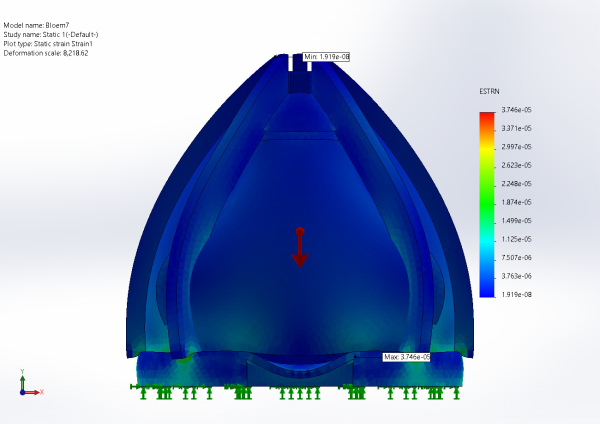
The maximum equivalent strain was 3.75 × 10⁻⁵, concentrated at the seat support region and 267 times below the elastic limit of birch plywood. The upper dome shows nearly zero strain confirming it is not load-bearing.
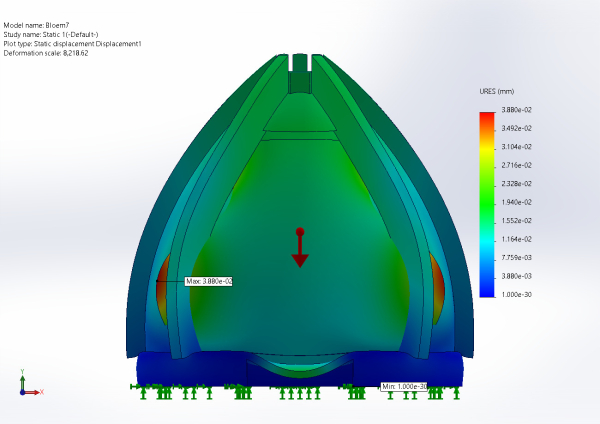
The maximum displacement was 0.0388 mm, less than half the thickness of a human hair and more than 100 times below the 5 mm threshold defined in EN 1728.
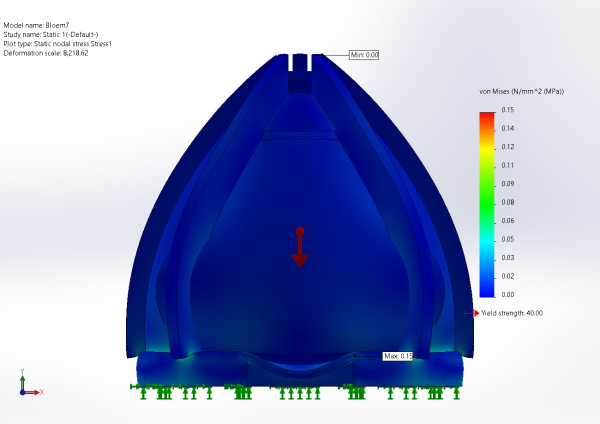
The maximum von Mises stress was 0.15 MPa at the base support region, representing only 0.375% of the material yield strength of 40 MPa, with no dangerous stress concentrations anywhere in the structure.

The minimum Factor of Safety was 261, more than 130 times the standard furniture target of 2.0. No region of the pod falls below a FoS of 5.
| Metric | Value | Limit | Verdict |
|---|---|---|---|
| Strain | 3.75 × 10⁻⁵ | ~1 × 10⁻² | PASS — 267× margin |
| Displacement | 0.0388 mm | 5 mm (EN 1728) | PASS — 129× margin |
| Von Mises Stress | 0.15 MPa | 40 MPa | PASS — 267× margin |
| Factor of Safety | 261 | 2.0 | PASS — 130× margin |
Test 2 — Worst-Case Concentrated Load:
A second simulation concentrated the full 1600 N onto a 200 × 200 mm patch at the center of the seat, representing the realistic contact area of a seated person. This produces a local pressure of 0.04 N/mm² and represents the most demanding loading condition for the seat structure. The patch was created using the SOLIDWORKS Split Line tool. The maximum von Mises stress under the concentrated load was 0.10 MPa, representing 0.25% of the material yield strength of 40 MPa. Stress dissipated rapidly through the surrounding rib structure with no dangerous concentrations elsewhere in the pod. The maximum displacement was 0.0367 mm, radiating outward from the contact zone while the base remained essentially stationary, confirming correct load transfer to the floor. The maximum equivalent strain was 3.649 × 10⁻⁵, tightly localised around the contact patch and fully within the elastic regime, meaning no permanent deformation occurs even under this demanding condition. The minimum Factor of Safety was 402, exceeding the standard furniture target of 2.0 by more than 200 times.
| Metric | Value | Limit | Verdict |
|---|---|---|---|
| Von Mises Stress | 0.10 MPa | 40 MPa | PASS — 400× margin |
| Displacement | 0.0367 mm | 5 mm (EN 1728) | PASS — 136× margin |
| Strain | 3.649 × 10⁻⁵ | ~1 × 10⁻² | PASS — 274× margin |
| Factor of Safety | 402 | 2.0 | PASS — 201× margin |
Color palette
The color identity of Bloem has been meticulously curated to foster a state of physiological and mental calm. The palette is composed of desaturated, nature-inspired tones that balance professional elegance with organic tranquility as shown in the Figure 17.
The strategic application of the palette is divided into three functional areas:
- Exterior Surfaces: The shades Plaster (off-white) and Mist (pale blue) are used for the capsule's outer shell. These tones allow the large structure to remain visually light and blend seamlessly into modern office environments without becoming a distraction.
- Interior Environment: The interior utilizes Moss and Eucalyptus greens as well as plaster. These shades are scientifically associated with stress reduction and focus. By surrounding the user with these deeper botanical tones, the capsule creates a “cocoon” effect that psychologically distances the user from the bright, high-pressure office atmosphere.
- Contrast and Accents: The shade Soot (deep charcoal) is used for structural details, hardware, and typography. This tone provides the necessary professional weight and high-end finish, ensuring that Bloem is perceived as a sophisticated tool for corporate wellness.
The synergy of this palette ensures that every touchpoint reinforces the brand's promise: providing a quiet, restorative space where users can truly “bloom.”
Smart System
Hardware
Figure 25 shows the block diagram of the capsule system. At its core is a microcontroller, which is connected to a RGB LED strip and light sensor. All components are powered by an external power supply. The microcontroller communicates wirelessly with an application via Bluetooth/Wi-Fi. The application acts as the central control hub, managing communication with the ESP32 and thereby controlling the lighting system. In addition, the app connects to a Bluetooth speaker to provide audio within the capsule.

To determine the most suitable components for the system, a comparative analysis was conducted. Multiple components were evaluated based on key parameters such as performance, functionality, and size. The following presents a comparison of microcontrollers (Table 45) and LED strips (Table 46). This comparison forms the basis for the final selection of components used in the project.
| Microprocessor | Arduino UNO R4 [41] | ESP32 Dev Module [42] | Raspberry Pi 4 [43] |
|---|---|---|---|
| Processor | 48 MHz | Up to 240 MHz | 1.8 GHz |
| Wi-Fi | IEEE 802.11 b/g/n (Wi-Fi 4) | IEEE 802.11 b/g/n (Wi-Fi 4) | IEEE 802.11ac (Wi-Fi 5) |
| Bluetooth | Bluetooth 5 | Bluetooth 4.2 / BLE | Bluetooth 5 |
| Power | 5 V DC via USB | 3.3 V DC via USB | 5 V DC via USB |
| Form factor | 68.6 × 53.3 mm | 51 × 28 mm | 85.6 × 56.5 mm |
| Feature | RGB LED Strip [44] | Single Color LED Strip [45] | Tunable White LED Strip [46] |
|---|---|---|---|
| Color Options | Color changing | Fixed | Adjustable white |
| Control | App / Microcontroller | On-off / Direct power | App / Microcontroller |
| Voltage | 5–12 V DC | 5–12 V DC | 5–12 V DC |
| Connections | 4 (R/G/B + V/GND) | 2 (+V / GND) | 3 (Warm / Cool + V/GND) |
| Notes | Can produce millions of colors | Simple and low cost | Mood adjustment with white tones |
Based on this analysis, we have chosen the ESP32 Dev Module. It offers a high processor speed and provides excellent flexibility for connecting sensors while still being compatible with the Arduino platform. Likewise, we want to give ourselves the option to use multiple colors of lighting in the capsule, which is why we have selected RGB LED strips. Below, we present a summary of all the electrical hardware components that will be part of the capsule.
Electrical Components Overview:
- 12 V Power Supply: Supplies power to the system and LED strip.
- Buck Converter: Steps down voltage for low-power components.
- RGB LED Strip: Enables flexible and dynamic lighting.
- Light Sensor: Adjusts lighting based on ambient conditions.
- ESP32 Dev Module: Provides control and wireless communication.
- 3 × Resistors (1 kΩ): Protects components and limits current.
- 3 × Transistors (IRLZ44N): Controls higher current to the LED strip.
- Speaker (Bluetooth): Provides audio output.
- Tablet: Acts as the user interface.
This section describes the schematic design of the system shown in Figure 26. The diagram illustrates the integration of the main components and their interactions. The ESP32 functions as the central controller and is responsible for controlling the lighting of the capsule. A light sensor is included to detect ambient light levels and determine when a session should begin. The capsule uses a 12 V RGB LED strip with four connections: a 12 V supply line and three control lines for red, green, and blue. The color and brightness are controlled using pulse-width modulation (PWM). Each control signal is generated by a digital output pin on the ESP32 and passes through a resistor and a logic-level N-channel MOSFET. This setup allows the low-voltage ESP32 to safely control the higher voltage and current required by the LED strip. Power is provided by a 12 V power supply. Since the ESP32 and sensor require a stable 3.3 V supply, a buck converter is used to step down the voltage accordingly. Additionally, the ESP32 communicates with a mobile application via Bluetooth Low Energy (BLE), enabling configuration and control of the system. It is important to note that this design represents an initial draft, developed to explore component selection and overall system integration.

To ensure the system operates reliably, a power budget was established for all electronic components. Table 47 below outlines the voltage, maximum current draw, and resulting power consumption for each component. The data is based on the datasheets of each component.
| Component | Rail | Max Current | Power (W) | Note |
|---|---|---|---|---|
| ESP32-WROOM-32 | 3.3 V | 500 mA | 1.65 W | During Wi-Fi activity |
| BH1750 Sensor | 3.3 V | < 1 mA | ~0.01 W | I2C communication |
| LM2596 Loss | 12 V | ~50 mA | ~0.6 W | Based on ~ 80 % efficiency |
| RGB LED Strip (3 m) | 12 V | 3.6 A | 43.2 W | Full white brightness |
| Total System | 12 V | ~3.8 A | ~45 W | Input requirement for J3 |
The power budget analysis shows that the system has an estimated total power consumption of approximately 45 W, where the RGB LED strip constitutes the primary load. In comparison, the ESP32 and connected sensors contribute only a minor portion of the overall consumption, while losses in the voltage regulation stage are relatively small but included in the calculation. Based on this analysis, the system requires a 12 V power supply capable of delivering at least 3.8 A. To ensure stable operation under varying load conditions, a safety margin should be applied. Therefore, a power supply in the range of 5–6 A (60–72 W) is recommended. Overall, the power budget confirms that the system design is r well-justified in terms of power requirements.
Software
The software component of the Bloem project is responsible for enabling the interaction between the user and the capsule environment. It consists of a mobile application installed on a tablet and an embedded control system running on a microcontroller. Together, these elements allow the user to book sessions, control environmental settings, and experience a guided relaxation process.
The tablet application acts as the main interface between the user and the system. It is designed with a calm and minimal user interface, using simple navigation, large touch elements, and soft visual feedback to align with the relaxing purpose of the capsule. The application allows users to quickly book a session, select a time slot, and adjust lighting and sound settings without unnecessary complexity.
The embedded system, implemented using a microcontroller (ESP32), is responsible for executing commands received from the tablet application. It controls the lighting system, manages audio triggers, and processes sensor data when necessary. This separation between interface and control ensures modularity and simplifies both development and maintenance.
Use Cases and User Stories
The Bloem system supports a set of focused interactions that define the user experience, which are explained in Table 48.
| Use Case | Description | Main Actor |
|---|---|---|
| Book a session | The user selects a session duration and an available time slot | User |
| Start session | The user initiates the relaxation session | User |
| Adjust lighting | The user changes brightness or selects a predefined lighting mode | User |
| Adjust sound | The user selects a sound environment or silence | User |
| Run session | The system maintains the selected environment during the session | System |
| End session | The session ends automatically or is stopped manually | User / System |
Table 49 highlights the user stories.
| ID | User Story |
|---|---|
| US1 | As a user, I want to quickly book a session so that I can relax without waiting |
| US2 | As a user, I want to choose a time slot so that I know when the capsule is available |
| US3 | As a user, I want to control lighting so that I can create a comfortable environment |
| US4 | As a user, I want to select sounds or silence so that I can personalize the experience |
| US5 | As a user, I want a simple interface so that I can use the system without confusion |
| US6 | As a system, I want to automatically end sessions so that the capsule is available for the next user |
Selection of Development Platforms and Software Components
The Bloem system requires both a front-end application and an embedded control system. Different options were considered for the tablet application shown in Table 50.
| Option | Advantages | Disadvantages | Suitability |
|---|---|---|---|
| Native Android application | Full access to device features, high performance, stable user experience | Platform-specific development | High |
| Cross-platform mobile framework | Faster development and shared codebase | Additional abstraction layer, possible performance trade-offs | Medium |
| Hybrid application | Easier UI development, flexible design | Limited hardware integration, less optimized | Medium |
For Bloem, a native Android application is considered the most suitable option. It allows direct integration with the tablet hardware, ensures smooth performance, and provides better control over the user interface and device communication.
The selected software components are summarized in Table 51.
| Component | Technology | Purpose |
|---|---|---|
| Tablet application | Native Android app | User interaction and session control |
| UI design | Custom interface (Bloem design system) | Calm and intuitive experience |
| Embedded firmware | ESP32 (Arduino framework) | Hardware control and system logic |
| Communication | Wi-Fi and Bluetooth local communication | Data exchange between tablet and ESP32 |
| Session management | Internal app logic | Controls timing and session flow |
Software Architecture
The software architecture is divided into two main layers: the user interface layer and the hardware control layer.
The tablet application manages all user interactions, including session booking, environment configuration, and session control. Once the user selects a session and its parameters, the application sends commands to the embedded system.
The ESP32 receives these commands and applies them to the physical lighting component. During the session, the system maintains the selected environment and ensures that the session duration is respected through a timer mechanism.
This architecture ensures a clear separation between user interaction and hardware control, making the system easier to develop, test, and extend.
Interaction Diagram
Figure 27 illustrates the interaction between the user, the tablet application, and the hardware components of the Bloem system.

Packaging
Given the significant scale of Bloem and its commitment to sustainable logistics, the packaging is designed as a high-end, industrial Flat-Pack System. Instead of shipping a voluminous, pre-assembled structure, the capsule is divided into modular components that optimize transport space and significantly reduce the carbon footprint of delivery. This system is specifically engineered for professional B2B handling, ensuring that all large-scale vertical ribs and delicate acoustic layers are protected during transit to corporate environments. The packaging utilizes heavy-duty, reinforced recycled kraft liners with a structural internal framework that mimics the protection of traditional wooden crates used for fine furniture, yet remains entirely plastic-free and recyclable. As shown in Figure 28, each component is nested within custom-molded pulp inserts that secure the cork tiles and hemp blocks, while the exterior of the crate serves as both a technical manual and a brand statement. Using monochromatic, eco-friendly inks, the surface displays the assembly hierarchy and the structural logic of the project, providing immediate visual guidance for the professional installation team. Centered prominently on the main face of the packaging is the brand’s core promise: “Space to breathe, room to bloom.” This serves as the final touchpoint of the delivery process, signaling that once the industrial protection is removed, what remains is a sanctuary designed for professional clarity and personal growth.

Prototype
Structure
The prototype was developed based on the principles of the 3D model. It was designed as a puzzle-like construction that could be assembled without the use of nails. During the planning phase, the intention was to create a full-scale replica of the 3D model, including all insulation layers and the wooden exterior of the capsule. However, this proved to be too ambitious within the available time and resources. As a result, the decision was made to complete the prototype using paper instead of wood for the outer shell. Consequently, a significant amount of the originally ordered materials remained unused. The prototype was built at a scale of 1:6,25. This scale was chosen because it matched the dimensions of the wood that had been purchased for the project and fits the budget of the materials for the prototype. In figure 29 below, the wooden framework of the prototype can be seen, which was constructed first. It fits together like a puzzle. The capsule’s hardware is integrated into the base, where it controls the lighting and audio system through an app.

As a next step, the outer shell of the capsule was added, as shown in Figure 30. Initially, thin wooden panels were considered to replicate the intended final design. However, during the prototyping process it became evident that the wood was difficult to bend into the required curvature. Various bending techniques were tested, but the material either failed to maintain its shape or cracked under stress. As a result, cardboard was selected as an alternative material for the prototype. The cardboard panels were attached to the wooden framework using staples, allowing the curved geometry of the capsule to be represented accurately while reducing manufacturing complexity. Although this differs from the final design, where the wall panels are intended to be inserted into the base floor and structural ribs, the prototype successfully demonstrates the overall shape, construction principle, and assembly concept of the capsule.

As a final step, an insulation layer was planned to be integrated into the prototype in order to represent the acoustic concept of the final product. Since the intended materials, namely hemp insulation and cork panels, would have significantly exceeded the available prototype budget, bubble wrap was selected as a low-cost substitute. Although it does not provide the same acoustic performance, it allows the insulation layer and wall composition of the capsule to be demonstrated visually. At the time of writing this report, the bubble wrap had not yet been delivered and therefore could not be installed. The material will be added to the prototype as soon as it becomes available. Several elements of the final design were intentionally simplified or omitted from the prototype due to limitations in time, budget, and available resources. In particular, the sliding door and its guiding mechanism, as developed in the 3D model, were not implemented. Manufacturing a functional door system would have required additional materials, increased construction complexity, and exceeded the scope of the prototype phase. Similarly, the seating area and interior cushioning were not included. The available space inside the prototype was reserved for the installation and testing of the LED lighting system, which was considered a higher priority for demonstrating the intended user experience. Despite these simplifications, the prototype successfully validates the overall dimensions, structural concept, assembly process, and visual appearance of Bloem. It therefore serves as an effective proof of concept and provides a solid basis for future iterations incorporating all planned features of the final product.
Hardware
Regarding the prototype’s hardware, the primary focus has been to integrate a reliable and functional LED-based light source. To enable user control of the lighting in Bloem, a client–server architecture was implemented. In this setup, the ESP32 operates as a client, communicating with a server defined within the application. The client receives commands from the server, which processes user input from the app and returns responses that change the color of the LED. Figure 30 shows the data flow.

This architecture ensures separation between the user interface and the hardware layer, allowing for scalable and flexible control. As a result, a fully functional prototype was developed, where the lighting inside the dome can be controlled by the user through the application.
In Figure 32 below, the prototype of the LED strip is shown. A main on/off button has also been included, allowing the system to be controlled with a single switch. When the system is turned on, a green LED indicates that it is active and functioning correctly.

The client receives commands from the server in a simple string-based message format, for example: message = “RGB:255,0,0\n”. In this case, the LED will only emit red light, as the red value is set to 255 while the green and blue values are set to 0. The client code reads the incoming message by checking if it starts with the “RGB:” prefix. It then extracts the red, green, and blue values from the string and converts them into integers, which are used to control the LED output. The code developed in the Arduino IDE is included in the Deliverables section.
Software Implementation and Code Flowcharts
The Bloem application was developed as a native Android tablet app. The app is responsible for the main user interaction, including booking a session, browsing available environments, starting or ending a session, and controlling the capsule atmosphere. This solution was chosen instead of a website because it provides a more stable experience on the tablet and allows easier integration with local functions such as sound playback and hardware communication.
The prototype software is divided into two main parts. The Android app manages the interface, session logic, timer, and audio playback through a Bluetooth speaker. The ESP32 is responsible for controlling the LED lighting system. Communication between the app and the ESP32 is done through Wi-Fi using TCP commands.

In the above Figure 33 the flowchart shows the session booking process. The user opens the app, selects “Book a Session”, chooses the session duration and time slot, and confirms the booking if the selected slot is available. If the slot is unavailable, the app displays an error message and allows the user to choose again.

In the above Figure 34 the flowchart shows the session control and environment flow. When an active booking exists, the user can choose an environment preset, such as Calm, Ocean, Rain, or Energetic. The app then manages the session timer, plays the selected sound through the Bluetooth speaker, and sends lighting commands to the ESP32.

In the above Figure 35 the flowchart shows the TCP communication used for LED control. When the user selects a color, the app converts it into RGB values, creates a command string, connects to the ESP32, sends the command, and waits for an acknowledgement response. If the response is valid, the app updates the interface as successful; otherwise, it displays an error.
Overall, the flowcharts explain how the app separates the user experience from the hardware control. The tablet application handles interaction and audio, while the ESP32 manages the physical lighting system inside the capsule.
Tests & Results
Hardware tests
The hardware tests specified in Tests are presented in the table. As shown in Table 52, some of the functional tests for the hardware components were not implemented in the prototype and were therefore not tested. We have tested all the features that were implemented, and these passed. We prioritized implementing the lighting system in the prototype and only simulated the acoustic functions by adding layers to the structure.
However, due to limited access to appropriate materials, we did not achieve a fully soundproof capsule. In addition, the prototype does not include a functional door, which also affects acoustic performance.
| Functionality | Test Result |
|---|---|
| F1 – External speech is noticeably reduced inside the capsule | Not tested |
| F2 – Sound from inside is not clearly understandable outside | Not tested |
| F3 – LED responds to app control | Pass |
| F4 – Response time is within 1–2 seconds | Pass |
| F5 – No visible flickering during operation | Pass |
| F6 – Light feels comfortable for users | Pass |
| F7 – Sufficient air circulation is maintained | Not tested |
| F8 – Users feel comfortable while using the space | Pass |
Software tests
Software Tests
The Bloem mobile application was tested through functional, performance, and usability tests. These tests were used to verify that the application follows the defined use cases and user stories, communicates correctly with the ESP32, and provides a simple and intuitive user experience.
Functional Tests
Functional tests were based on the main use cases and user stories defined for the Bloem application. Each function was tested manually on the Android prototype to check whether the expected app response and hardware behaviour occurred correctly.
| Test ID | Related Use Case / User Story | Test Description | Expected Result | Status |
|---|---|---|---|---|
| FT1 | Book a session | User selects session duration and available time slot | Booking is confirmed and session is saved | Passed |
| FT2 | Book a session | User selects an unavailable time slot | App displays an unavailable message and asks the user to choose again | Passed |
| FT3 | Start session | User starts a booked session | Session timer starts and environment options become available | Passed |
| FT4 | Choose environment preset | User selects Calm, Ocean, Rain, or Energetic | Correct sound and lighting preset is selected | Passed |
| FT5 | Set LED color | User selects a light color in the app | RGB command is sent to ESP32 and LED color changes | Passed |
| FT6 | Control sound setting | User selects a sound option | Audio plays through the tablet and Bluetooth speaker | Passed |
| FT7 | End session | User ends the session manually or timer expires | Audio stops and LED system is reset or turned off | Passed |
| FT8 | Connection error | ESP32 is unavailable during LED command | App displays an error message and does not crash | Passed |
Performance Tests
Performance tests focus on the communication between the Android app and the ESP32, as well as the responsiveness of important app operations. Each critical operation was repeated in order to calculate the average runtime and standard deviation.
| Test ID | Operation | Data Exchanged | Repetitions | Metric Measured | Average Result ($\mu$ ms) | Standard Deviation ($\sigma$ ms) |
|---|---|---|---|---|---|---|
| PT1 | Send LED color command to ESP32 | 21 B (RGB command + ACK) | 10 | Runtime / latency | 76.90 | 15.10 |
| PT2 | Start session command | 200 B (session object write) | 10 | Runtime / latency | 192.30 | 31.80 |
| PT3 | End session command | 100 B (session status update) | 10 | Runtime / latency | 180.00 | 30.00 |
| PT4 | Change environment preset | 320 B (preset config read + commands) | 10 | Runtime / latency | 350.00 | 70.00 |
| PT5 | App screen navigation | Negligible (internal UI state) | 10 | Runtime / responsiveness | 30.00 | 5.00 |
Summary
The prototype demonstrates a functional and well-integrated system combining both hardware and software components. The structural design reflects the intended capsule form, while the LED lighting system, controlled through a client–server architecture, operates as expected. The Android application provides an intuitive user interface, enabling session booking, environment selection, and real-time control of lighting and sound.
Although some elements of the design were simplified or not implemented due to limitations in time, budget, and materials, the prototype still successfully validates the core concept and key functionalities of the system. Both hardware and software testing indicate that the implemented features perform consistently and meet the defined requirements.
This leads to the final discussion of the project, where the achievements, limitations, and future development will be presented.
Conclusions
Achievements
The primary objective of this project was to develop a sustainable and user-centered solution that supports mental well-being in modern work and learning environments. This objective was successfully achieved through the design of Bloem, an egg-shaped relaxation capsule that combines acoustic insulation, privacy and digital well-being features. Throughout the project, the team conducted market research, competitor analysis, technical development and sustainability assessments to create a concept that addresses the growing demand for dedicated microbreak spaces. The final outcome includes a complete product concept, a detailed 3D model, technical drawings, a prototype, a business model and a marketing strategy. The project also successfully integrated several key requirements identified during the preliminary studies, including acoustic separation from the surrounding environment, sustainable material selection, passive ventilation, user comfort and digital support through guided relaxation content and a reservation system. Although the main objectives were achieved, some aspects could not be fully validated within the timeframe and resources available for the project. In particular, comprehensive acoustic measurements, long-term user testing and full-scale industrial production validation were beyond the scope of this project.
Limitations
Despite the successful development of the concept and prototype, several limitations remain. Firstly, the acoustic performance of the capsule has been designed based on material properties and engineering assumptions but has not yet been verified through professional laboratory testing. Consequently, the exact level of sound insulation cannot be guaranteed at this stage. Secondly, the prototype represents a proof of concept rather than a fully industrialized product. Certain construction details, such as the door mechanism and assembly process, require further refinement to improve manufacturability, durability and user experience. Another limitation concerns the ventilation system. While passive airflow has been incorporated into the design, additional testing is required to validate air quality, thermal comfort and CO₂ levels during extended use. Finally, the effectiveness of Bloem in reducing stress and improving user well-being has not yet been evaluated through long-term studies involving real users. Further testing in office and educational environments would be necessary to quantify the impact of the solution on mental well-being and productivity. In addition, the prototype had to be constructed using alternative materials due to budget constraints. The planned door mechanism could not be implemented, as bending the wood to match the required curvature at such a small scale would likely cause it to break. Furthermore, to better demonstrate the capsule’s structure, material layers, and overall functionality, a larger-scale prototype would be recommended in future iterations, as it would provide a more realistic representation of the final design.
Future Development
Although Bloem successfully demonstrates the feasibility of a dedicated microbreak capsule for modern workplaces, several aspects can be further developed and validated in future iterations. A primary area for improvement is acoustic performance. While the current design utilizes a multi-layer wall system consisting of cork, hemp and wood, future prototypes should undergo professional acoustic testing to quantify sound insulation and identify opportunities for further optimization. This would ensure that the capsule provides a consistently quiet environment even in highly dynamic office settings. Another important development concerns the ventilation system. The current concept relies on passive airflow through strategically positioned openings. Future versions could integrate smart ventilation solutions with air quality and CO₂ sensors to automatically regulate airflow while maintaining acoustic comfort. The digital ecosystem surrounding Bloem also offers significant potential for expansion. Future developments may include personalized user profiles, integration with corporate wellness platforms, usage analytics and AI-supported recommendations for relaxation exercises, breathing techniques, or guided meditation sessions tailored to individual needs. From a manufacturing perspective, additional work is required to optimize the structure for large-scale production. This includes refining the joinery system, reducing assembly time and further improving the flat-pack packaging solution to minimize transportation costs and environmental impact. Finally, long-term user studies should be conducted to evaluate the effectiveness of Bloem in reducing stress, improving well-being and increasing workplace satisfaction. Such studies would provide valuable data to support future product development and strengthen the business case for implementation in offices, coworking spaces, universities and other shared environments.